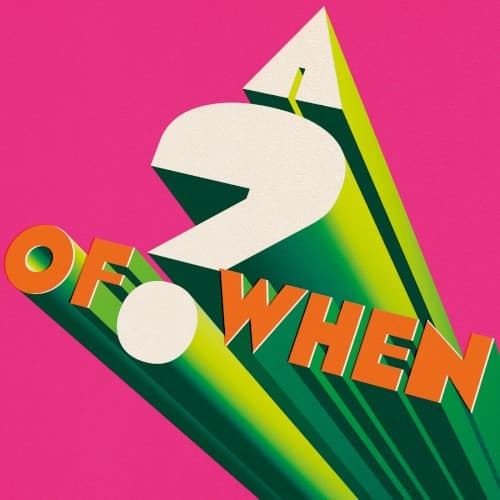
A piece of art can stick around for a million reasons, but a common determinant of longevity lies in its readiness to be reinterpreted. With each passing decade comes a fresh vantage point; successive generations and new thinkers clear novel paths to the same destination.Aldous Harding's records illustrate this theory in accelerated miniature. A dozen listens to Train on the Island, the New Zealand songwriter's mesmerizing fifth record, will yield a dozen interpretations, a century's worth of pondering and re-pondering condensed into 40 minutes.Harding's trick, of course, is that all this interpretation leads you nowhere. "People are just so keen to get to the bottom of stuff that's none of their business," she said in 2019, back when she still did interviews and her singles were accompanied by expository statements. Spelunking through her latest only pulls you deeper into the belly until you realize, after all the calculations and diligent note-taking, you've become hopelessly stuck. Rather than panic, you let yourself slip into sleep.It's in the dream that Train on the Island comes alive. The burbling, minor-key skulk of "I Ate the Most" introduces the record underwater, kicking upward with distinct pearls of plot — a preoccupation with children and their parents, with bingeing, purging and growing — that Harding drops back into the depths just as readily as she surfaces them. It also opens with the fabulous, biting couplet, "I'm not afraid, like you're not gay / And you're not old, like I'm on the spectrum." Harding is nothing if not funny.Train on the Island refines every aspect of the artist's songwriting without ever revealing her hand. There's the nagging feeling, though, as dangerous as it is to indulge, that she's stepped ever so slightly from the shadows this time. Recurring motifs of childhood memory and a compromised mental state ("I know things ain't working out / But they may come good later / Hope I'm more than I think about," she rumbles on the dense, roiling "What Am I Gonna Do?") feel like meaningful threads, perhaps the first time one could argue with any conviction that an Aldous Harding album is "about" something.And then the panic sets in again, and it's time to release yourself to the record's half-light. Whether these moments of assumed transparency exist at all feels like the least interesting thing about Train on the Island, where the the joy is in being tripped up; in facing an artist less interested in explaining herself than in expression. Harding is more heartbreaking, more hilarious and more complex than ever, her chameleonic knack for voice modulation and character mutating her craft to thrilling effect.The songs on Train on the Island tend to interrupt themselves, as prone to unpredictable tonal shifts as Harding herself: a perfect 22-second pop song suddenly appears on the bridge of the title track before it settles back into its muted strut, while the aching chorus of "What Am I Gonna Do?" is slow-mo piano balladry, and the opalescent "San Francisco" closes with the same strummed refrain as "One Stop," sunshine melting the clouds away. With longtime producer John Parish at the helm, Harding's music has never been more nimble and self-assured. The pair's sideways lingua franca — brought to life by a small coterie of musicians including H. Hawkline, who duets with Harding on the jubilant "Venus in the Zinnias" — is ripe with negative space, a small collection of sounds thats subtle perversion of folk and rock fundamentals feels distinctly modern.Harding closes things out with the spritely cowpunk "Coats," a tried-and-true pop song that hinges on the mystifying chant, "Big thick coats on the dogs of people / Just trying to help." It means something to Harding, certainly — but more importantly, it feels like it means something; a gesture of gratitude and a sense of uneasy fear, conjuring nostalgic comfort and a desperate search party in equal measure. It's this crucial mystery that makes Train on the Island such a spellbinding listen, the high water mark of Harding's singular career. On the penultimate "Riding That Symbol," she sings, "I'm only riding that symbol / No one knows what I'm into." A thesis statement if there ever was one.

Wavelength
Rate and discover music with friends