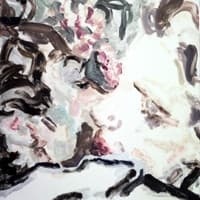
Since 2012, BIG|BRAVE's Mathieu Ball and Robin Wattie have consistently found a warm, safe place in the house of distortion. Treating signal and noise less as extremes to be reconciled than as mutual materials to be shaped, felt and inhabited, on their 10th album, in grief or in hope, that immersion feels more tangible than ever before.Foregoing the paintings and artfully blurred photographs that have typically decorated their previous releases, in grief or in hope opts instead for a landscape-oriented photograph Ball captured of a public trash can. Casting a strange spell on the beholder, it's a colour image, but the bin bag lining registers so dark that, without closer inspection, it appears to desaturate its sidewalk backdrop, absorbing the environment to which it belongs.Like a halo beyond an abyss, only a fold draped over the rim reflects light — and when you look closer, you can see life struggling to break through the cracks on the periphery. A seemingly mundane image becomes an unexpectedly potent metaphor.Grief, anxiety, shame and stress are treated as private burdens under neoliberal capitalism, and the onus of the management of these hardships has increasingly been downloaded to individuals rather than recognized as conditions to be addressed collectively and on a structural level. The body becomes a receptacle for accumulated social refuse.Throughout in grief or in hope, BIG|BRAVE repeatedly return to the body as both container and site of reckoning. "Trade this body for a piece of ease," Wattie's quivering voice begs through layers of guitar drone and her own vocal distortion at the top of opener "what may be the kindest way to leave." Elsewhere, songs like "skin ripper" and instrumental track "holding tongue" gesture at the implications of addressing trauma alone, itemizing the toll as it manifests in atomized nodes on one's figure. The body keeps the score, as it were, but in grief or in hope inverts the popular maxim, exploding individualized hurt as BIG|BRAVE convene a sonically radical critical mass. As emotional hardship is exorcised from the private interior and rendered into physical object, singular struggles dissipate through collective reckoning and maximum overdrive. Consciousness-raising takes place on the local level of the band itself here, Ball and Wattie's overdriven drones joined in the studio for the first time by longtime touring bassist Liam Andrews. Recorded live off the floor, the trio's instinctual responses to their each other's volleys of noise and feedback peal like a sacred convening of the bioelectrical impulses governing corporeal human bodies with raw voltage — amplifiers, pedals, guitars and speaker cabinets like vehicles for secular transubstantiation. A nod to the title track of 2014's Feral Verdure, "verdure" borrows the heaving industrial atonality of power electronics to visceral effect in its climax. However, it's the brutally hypnotic minimalist dance that plays out between a heavily distorted bass signal and the slow, steady, hollow knock of what sounds like a tapped pickguard registering through a guitar pickup that are undeniably responsible for the success of that later impact.In an atypical move, the penultimate "an uttering of antipathy" applies pitch-correction to Wattie's vocals, and the psychedelic, crystalline results glow across the discord of elephantine guitar feedback and thunderous bass like rays of light passing through stained glass — "A presence inverted," she sings. The spectre she gestures to multiplies in the space between two lines, adding, "None of them mine."Like the photograph on its cover, light touches only the edges of the darkness hanging over in grief or in hope, but that feels like enough. In transforming personal anguish into shared material, BIG|BRAVE provide listeners with a tangible reminder that grief will never belong to them alone, and make critical contact with a transcendent reality we can conceive of, even if it remains beyond full reach.

Wavelength
Rate and discover music with friends