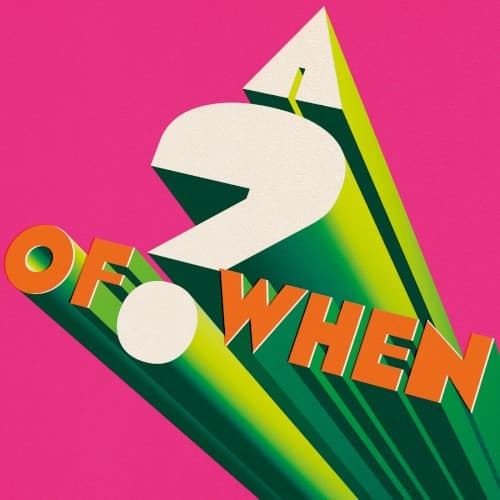


It takes some time to clock that Sol.Hz, the latest album from British ambient-dub droneshapers Seefeel, has even started. At first it’s just silence. If you’re listening on a phone or computer and you don’t have the volume turned up loud, you may at first wonder if some kind of glitch has interrupted the stream. But once your ears become accustomed to the foggy swell leaching into the air, the music comes on like financial ruin did for one of Hemingway’s characters: Gradually, then suddenly.
Without doing much of anything at all, that drone—coruscating, electric, quivering like a heat mirage over hot pavement—builds to its distorted peak, then abruptly begins its long downward slide back into silence, a nothingness that lingers longer than you’d expect. If you were to follow the track’s progression with a stopwatch, you’d realize that most of its running time is spent either fading in or fading out. It’s almost as though Seefeel preferred coming or going to staying in one place.
Seefeel have been coming or going for most of their career. After stepping out as maverick shoegazers with their debut album, 1993’s Quique, they pivoted to a forlorn, dub- and industrial-inflected strain of ambient music on 1995’s Succour and 1996’s (Ch-Vox). That was the last anyone heard of Seefeel until 2010, when they briefly resurfaced with an EP, followed by self-titled 2011 album whose fizzing guitars and desiccated drums suggested an unexpected debt to Steve Albini; then they fell silent for another 13 years, until a pair of mini-LPs, 2024’s Everything Squared and Squared Roots, burrowed a wormhole straight back to the desolate badlands of their mid-’90s run.
Sol.Hz, once again created by the core duo of Mark Clifford and Sarah Peacock, picks up where the last two records left off: in an uncanny netherzone where tonal shapes flit through the air like auroras, and stumbling electronic percussion crumbles to dust. Seefeel were the first guitar band signed to Warp, a label then known mainly for squirrelly bleep-techno anthems and fractal-folding armchair electronica; the guitar remains central to their music, but you’d never guess it from Sol.Hz. There’s no trace of anything strummed or plucked; clusters of tone simply materialize out of thin air, as capricious as weather.
This is billed as Seefeel’s dub album, which might beg some measure of skepticism: Didn’t they already do that with Squared Roots, an album-length rework of Everything Squared? But the new album’s rhythmic focus bears out the description. These are some of the heaviest grooves that Seefeel have created in ages, channeling lurching currents through intricate chains of dub delay. Yet they’re rarely straightforward—on a track like “Until Now,” the drums are distant and muffled, thrashing like an animal in a burlap sack. Throughout the album, the beats are felt primarily in the ribcage and the gut. The dub influence comes to the fore on “Everydays,” whose lumbering kick drum feels perpetually on the verge of falling to pieces; a hissing shaker skates over the top, seemingly pegged to its own distinct time signature. (The effect is remarkably similar to certain tracks on No Protection, Mad Professor’s dub rework of Massive Attack’s Protection.)
“Everydays” also dissolves into a strikingly long fade-out; so, in fact, do many of the album’s tracks. Take “AM Flares,” which takes a handful of loops—Cocteau Twins-like peals, toe-stubbing kick drums, airy streaks of color—and builds to a gentle peak before devoting nearly three minutes to a shimmering denouement, like stop-motion video of a Mylar balloon deflating. The more time you spend with Sol.Hz, the more you’ll realize just how much of the record is dedicated to intros and outros. But what happens in those interstitial periods, as micro-rhythms ripple outward from liquid collisions, is key to Seefeel’s approach. They often appear to be listening as much as they’re playing, content to let the effects boxes do their work, and determined to let an idea unspool for as long as it needs to.
Listeners who prize progression won’t find much of either here: Sol.Hz showcases Seefeel continuing to perfect something they have been doing for a very long time. The differences with previous records lie largely in tone and mood. Yet for reasons I can’t quite put my finger on, it feels more satisfying than the last two records. That might have something to do with its tonal sensibility: While the melodic sounds are as wispy as ever, they’re slightly more harmonious. And Peacock’s voice feels more recognizable as a voice than it has since some of their earliest work—less wraithlike, more comforting. Between the warmth of her singing and the full-spectrum embrace of Clifford’s treated guitars, it sometimes feels like Seefeel are finally closing the gap between their longstanding atmospheric sensibilities and the more pointed melodic thrust of Quique. No one would ever mistake present-day Seefeel for a shoegaze band, but they channel some of that sound’s emotive energy here—almost as if they were taking shoegaze to its logical conclusion and documenting its last, mournful gasp.