

Little George Bush was big for American noise. During his eight years in the White House, a glorious din poured from the underground’s every corner, caterwauling responses to wars and world orders built on lies. It was an extended heyday for harshness that doubled as an escape hatch—the rock deconstructions of Mouthus, the ecstatic roar of Growing, the crackling tectonics of Yellow Swans. Where No Fun documented the subterranean groans of New York, Not Not Fun broadcast its wonderfully garish West Coast cousins. Lightning Bolt felt like guerilla fighters, Sunn O))) like rebellious sages, Merzbow and Jazkamer and Birchville Cat Motel like blessed international allies. Not everyone had an ambient project yet, and new age was old news. Noise felt necessary, urgent.
In New Zealand, though, the guitarist Roy Montgomery largely sat that moment out. Montgomery had long been one for disappearing; soon after his band, the Pin Group, released the first-ever single on the great label Flying Nun in 1981, he seemingly vanished for a decade. What’s more, the music he made after returning in the mid-’90s was rarely savage. Scenes from the South Island and Temple IV were instead skeletal, beautiful, and haunted, the bittersweet transmissions of a man who had left home to process the loss of a lover and stumbled into two landmarks. His four-track compositions felt like frames for walls of noise, not the noise itself. When he didn’t release music from 2001 until 2010, it was as if he simply stepped aside for the kids who coveted his delicate work and let them rage. This wasn’t his fight.
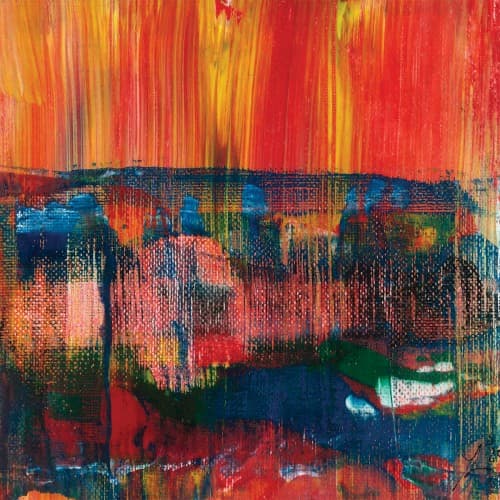
He does not cede the same ground on Guitars Infernal, the most obliterative music of his career and an invigorating throwback to the harsh glories of this millennium’s start. “This album is dedicated to the late planet Earth before it overheated,” reads the epitaph on the back cover. Montgomery recorded these nine instrumentals in 2016, as it seemed his world and ours were splitting open. Never mind elections or Brexit. His longtime partner and the mother of his children, Kerry McCarthy, was battling cancer. And along the Alpine Fault at the edge of two tectonic plates, New Zealand suffered a string of cataclysmic earthquakes, including one that prompted scientists to reconsider the way they worked. Montgomery turned on his Tascam digital 8-track and, in pieces named to memorialize a flammable planet, let out the rage.
Even at his most forlorn, Montgomery always had a knack for melody, the very thing that makes these nine onslaughts more memorable than some pure miasma. At the start of “Pyromantic Ideation,” he plays a quick little lick, like a blues guitarist warming up for a gig. For the next six minutes, rivers of distortion rise and fall and weave around the line, as if Montgomery has pushed the listener’s ear against a badly blown speaker. But he never lets go of that riff, clutching it even as the rest of his world drowns in static.
The acoustic slide line that anchors “Erstwhile Enervation” sounds like something that slipped out of some great lost Paisley Underground demo. Montgomery plays it so slowly and embeds it inside so many broken layers, though, that it warps into jangly doom, a heavenly hook relenting to high-volume pressure. “Immaculate Ignition” is as blown out as some black metal demo cut in the Helvete basement, but the piece is sculptural and symphonic, too. Overtones and harmonies float around the riff like an enormous string section. These are damaged songs, not merely fucked-up sounds.
More than two decades ago, in that period where he wasn’t releasing much music, Montgomery told Perfect Sound Forever how he worked. He’d put a first guitar pass down on his four-track, then add three more on top. He’d play the whole time, knowing that a piece may need to last for 10 minutes or more before he slipped into something interesting. Then, maybe, he’d lop off the rest. That process is especially poignant here, because almost everything feels like a fade-in. Montgomery reveals the hangman riff of “Lucifer’s Generation” patiently, while opener “Fleeting Illumination” evokes a danger you sense on the horizon long before it surrounds you. The effect is a true-to-life reminder of the gradual nature of most catastrophes. To borrow Montgomery’s construction, the planet Earth doesn’t suddenly overheat; heads in the sand, we let it happen. These pieces represent terrible epiphanies, then, documents of the moment when we know something is finally too far gone to fix.
Montgomery has made his most vital work in mourning. Those mid-’90s beauties represented a spell of transitional grief, cut in New York in part because he knew his late partner would not want him to sit still with his feelings. After McCarthy died in 2021, he released Camera Melancholia, a painful and pretty album about the dignity and joy of a person who was gone. Where they were elegies for people he had lost, Guitars Infernal is an outburst for something we are now in the process of losing. Like his American successors 20 years ago, Montgomery is protesting the present while mourning the future, alarm bells ringing no matter how many people aren’t listening.