
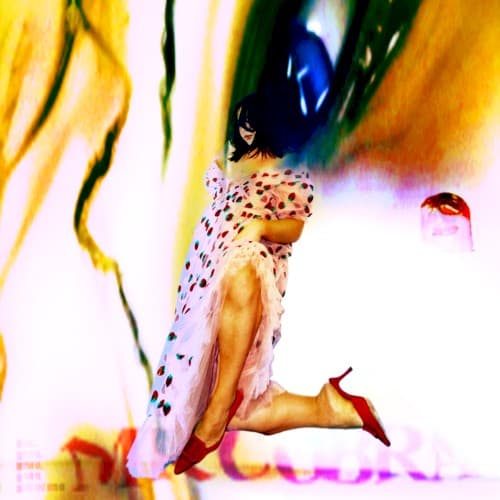
A little over two weeks ago, my friend brought me to Performance Space New York for Lucy Liyou’s one-night-only, one-woman “semi-autobiographical solo theater-music performance,” Mister Cobra. I went in completely blind, my only information prior to the show’s start being the warning ushers gave to the first two rows: you’re in the fake blood splash zone, watch out. Roughly an hour later, I was up on my feet for a standing ovation. Since that night, I’ve tried to put the experience into words, only to come up blank every time. It simply defies description—and so too does MR COBRA, the album Liyou created for the performance and released on Bandcamp last Friday. The album and show alike function as “a revisionist retelling of a time back in high school when [Liyou] fell in love with a predator,” but not in a conventional sense: the story is told through viscera and sensation, landing somewhere in the bones instead of the mind.
Mister Cobra, for its part, walked song-by-song through the record. As in the album itself, Liyou played the character of “Babygirl” while the disembodied, pitched-low voice of Jake Muir beckoned as the titular Mr. Cobra. A wide-screen projector flashed photos and footage and text throughout the entire runtime—a feast of oversaturation familiar to anyone who grew up in the digital age. One second a picture of Moo Deng, the next a collection of celebrities with pasted-on oversized eyes, the next a close-up of digitally fried tits. Pink Times New Roman text reading “daddy’s faggot can’t be a boy? daddy’s faggot can’t be a girl? daddy’s faggot can’t be an enfant (terrible)?”; a black-and-white picture of 1950s ventriloquist Jimmy Nelson; a poem about fingering yourself in public; a creepy overexposed video of plastic toy animals. In front of the screen, Babygirl wore a babydoll dress and stood on a slight rise in the middle of a sea of trash, next to a keyboard she frequently played throughout the show, sometimes with her hands, sometimes wearing boxing gloves, sometimes using a can of SPAM. But by the record’s end, Babygirl had long lost the babydoll dress; by then, she wore a white tee stained crimson by the fake blood covering every inch of her body, matted trash from the floor sticking to her red-slick skin. A tiara sat atop her head and a pageant sash encircled her torso: “Tranny of the Year.”
Cards on the table: it’s difficult for me to try and separate the record-as-record and the record-as-play. The vast majority of people hearing MR COBRA will not have been in the small audience for Mister Cobra that March night, but I was, so now I struggle to hear the hypnotic groove of “Crisis (Identity)” without seeing Liyou-as-Babygirl fellating a gray mannequin’s nondescript bulge with a mouth of full of blood, leaving a smear of red in her wake as she goes about tearing its arms from its limbs. “Lair Lair Pants on Faire” is forever interwoven with the sight of Babygirl burrowing into an ocean of garbage in front of a stock image of a creepy basement, panicking when the sound of Mr. Cobra’s footsteps echo down the fictional staircase. Do the sounds of cartoon violence two-thirds through “Self-Mutilating Missus” hit as hard to listeners who don’t associate it with the cheery mutilation of an image of Liyou as a child, who don’t flinch at each silly “bang” because they haven’t seen them accompany clip-art weapons brutally slamming into an eight-or-so-year-old? Probably not. Therein lies the problem with tying a record so heavily to a one-night performance, I suppose.
But while there’s simply no way the album alone could replicate the impact of the full, blood-soaked, multimedia extravaganza I witnessed on March 28th, MR COBRA does a damn good job of standing on its own two feet. Case in point: my editor, who did not see Mister Cobra, texted me to say the record is an example of an album that’s “truly changing the way I think about music.” And, well, how could it not?
As Liyou whispers, apropos of nothing, around the 90-second mark of “Crisis (Identity)”: “This is not music.” If we take our working definition of “music” straight from Merriam-Webster and define it as “vocal, instrumental, or mechanical sounds having rhythm, melody, or harmony,” she is, technically, quite correct. Rhythm, melody, and harmony are all rather rare sights across the album’s 50-odd minute runtime. If it’s not music, though, what is it? A “humiliation ritual,” as Liyou puts it? A musique-concrète haunted house, with found samples and hushed, pitched whispers lurk around every corner? A work of theatre, of performance art, in its own right, immersive and all-encompassing? A standup routine, rerouting pain into a tight five (or, well, 50)? A version of music that we don’t yet have a word for nor likely ever will, something that simply cannot be bound by the limitations of language? All of the above and then some, likely.
I don’t think there’s a single artistic medium that escapes Liyou’s grasp on MR COBRA; you’d be hard-pressed to find a form that doesn’t appear somewhere on it. (The album has 13 genre tags on Bandcamp, including opera, pansori, animal, baroque, K-pop, ambient, Korean, nursery, and disco house among its ranks. It also lists 15 collaborators, from Nick Zanca to Patrick Shiroishi to Laura Cocks.) It’s camp, it’s drag, it’s slapstick, it’s poetry, it’s technology; it’s all music and none of it is. Dialogue between the album’s two characters is scattered throughout; take “Babygirl,” the first full track on the record: there’s a whisper from Babygirl here (“I’ve got some big tatas… and they jiggle too”), a response from Mr. Cobra there (“Hey babygirl, let me see your tatas… You are nothing but a boy”), even a surprise interpolation from 1968 horror flick Rosemary’s Baby (“What have you done to his eyes?! What have you done to him, you maniac?!”). Songs and films are sampled with reckless abandon; “Gojira Dearest” transforms screams straight from Godzilla (fitting, given “Gojira” is the original Japanese word for Godzilla) into a pure wall of noise, then pulls from 1981’s Mommie Dearest (“Nothing really happened between your daughter and the young man, it was innocent!”).
“911, A Kidnapping” seems to lean heavily on field recordings, fried-to-shit street sounds mixed with near-inaudible whispers giving traffic directions; “Lair Lair Pants on Faire” serves up a concoction of messy free jazz piano, violins high and fast enough to be mistaken for a horde of mosquitoes buzzing in the ear, and Babygirl’s syrupy-sweet coos of adoration. The final song is all grainy, horrid, industrial noise with whispers of “I wanna die / I wanna fake die” splattered across the wall of noise, before eventually transforming into a piano ballad befitting a celebratory pageant walk. Then there’s “Old MacDonald Had A Charm,” which, man, you really just have to listen to for yourself—Babygirl eerily intones the old nursery rhyme, yet is cut off every so often by bursts of a distorted sonic hellscape or an automated female text-to-speech voice that rapidly spits out lines like, “What would you as a pathetic middle aged white man desperate for a taste of spry Korean pussy know about the magnitude of a girl like me?” But by the end of the track, she’s right back in Mr. Cobra’s clutches, panting and moaning in his arms while a chorus of farm animals sounds off around her.
While, yes, the majority of the record is undoubtedly comprised of bizarre, disparate, ineffable hyper-experimentation—not, say, the sort of thing you’d throw on in the car or blast while cleaning your room—the moments Liyou does veer into traditional “music” (rhythm, melody, or harmony) are magical. Mid-record ballad “Romeopathy” is light and delicate and full of soul, propped up by heavenly synths and a sample of Taylor Swift’s “Love Story.” The opening to album standout “Crisis (Identity)” is an utter earworm (“Might not be what you’ve envisioned / Might not be what you’ve been missing / But losing your temper will prove me wrong” has been stuck in my mind for days). The dance-pop number “Constrictor (Haha)” is another high point. The sound is brilliantly led by the narrative within it: an upbeat, romantic boogie at the beginning is cut off by Mr. Cobra’s harsh whisper of “Relax. Please. Relax.” and the boos of a crowd, then after a slow build back to reconciliation with Mr. Cobra we’re taken up-tempo once more, anxiety now stitching the seams together even as the chorus reprises. It’s a self-contained arc in its own right, even outside of the journey of MR COBRA—a series of emotions utterly familiar to any girl who has ever expressed love and been told by a man to calm the fuck down, keep it quiet, be the cool girl. The song, naturally, ends with a car crash. These moments of melody, harmony, and rhythm are few and far enough between to falsely feel like salves when they arrive, a relieving return to something resembling “normalcy.” It’s a clever ruse on Liyou’s part; she pulls the rug out from under you every time.
Really, the issue with MR COBRA is that it puts me, the reviewer, in the terrible predicament of having to say something as insufferably trite and pretentious as “it’s not merely an album, but an experience”—because, damn it all to hell, that’s exactly what it is. The critic is trapped between a rock and a hard place, here: our job is to render a work of art legible, yet MR COBRA vehemently denies legibility at every turn. Not in the sense that it defies easy comprehension (although it does), but in that it seems to argue that legibility itself is dangerous, an act of unmaking in its own right. So how do I categorize, describe, and define a record that spends almost an hour exploring just how detrimental categorization, description, and definition can be? What do I even say? That it’s a multimodal mindfuck that dissolves the invisible barriers between form and content, medium and medium? That, screw Merriam-Webster, it broadens the very notion of what music is and can be, blowing it up into something expansive and unquantifiable? That, in doing so, it both exemplifies and extends its own thematic dissolution of the invisible barriers between self and spectator, past and present, performance and personhood, culture and inheritance, gender and gender?
I could. It’s all true. I just worry that grafting words onto the record somehow does it a disservice. So I suppose all I’ll say is this: throughout the record’s 12 tracks, Lucy Liyou dances and crawls and bleeds through pain and sex and trauma and transition and desire and shame and acceptance; fear and pleasure are crushed into a singularity of feeling that lodges in the throat; selfhood is found in everything and nothing at all; and you’ll simply have to listen to it—or, if Mister Cobra runs again, see it—for yourself. [Orange Milk]
Casey Epstein-Gross is Associate Editor at Paste and is based in New York City. Follow her on X (@epsteingross) or email her at [email protected].