

Who could forget the strained hope of post-vaccination social life? Masks in the park. Elbow bumps. Portable hand sanitizer. The irrational belief that plexiglass partitions could fend off the COVID-19 virus as we dined indoors, as if swirling, microscopic vapor particles would halt and retreat like obedient soldiers. We later learned that breath aerosols simply wind around these barriers, drifting like cigarette smoke, partition be damned.
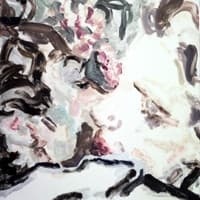
Amid the pandemic, and because of it, Norwegian avant-garde artist Jenny Hval considered less nefarious vapors. As live performances became a public health liability, Hval revived her teenage fascination with perfume, and christened her ninth album Iris Silver Mist after a beloved scent of the same name. The $320 fragrance from French company Serge Lutens, crafted in the mid-1990s by renowned nose Maurice Roucel, has been called “the powderiest, rootiest, most sinister iris imaginable,” as scent authority Luca Turin put it in his five-star review. For Hval, the perfume evokes the stages of its making: an alchemic transformation from plant matter to glorious vapor; a “flower that is a root that has died, been resurrected and finely grated,” as she has described it. The 13 songs indebted to this scent examine such grand states of flux: between present and past, tactile and intangible.
Of all the liminalities Hval mines on Iris Silver Mist, the most intriguing and prevalent is performance itself. On the sauntering “I don’t know what free is,” Hval questions the definition of creative practice: “I tried to ask ‘What is a performance?’/What is to write?” she sings, her clean falsetto arching over synthesized organ thrums, threatening to vanish at any moment. The earthier “All night long,” with its skeletal percussion and rippling, fingerpicked guitar, portrays performance as the ultimate expression of existence: “As long as I’m performing I am not choosing, or dying/I am performing in the speed of light,” Hval says, speaking softly but plainly. Following this revelation, the song opens into a cosmic jazz refrain, and Hval demonstrates an even purer act of performance: nonverbal singing that mirrors the melody with the unfettered charm of a child humming to a car radio.
Impermanence is a threat and a delight across Iris Silver Mist. “Instruments packed/The stage lights are cut/The beer you just spilled on the floor has dried out,” she sings on “The gift”; like perfume, the spilled beer changes over time, once fresh and now sticky and stale. On “The artist is absent,” the record’s clubbiest number, Hval sings in a register so high her words are almost indecipherable. She warns of “a stage without a show/A hazy silhouette… A club without a club” atop gritty synths and a driving beat that collapses into a tangle of distortion. An ambient hiss seeps into the following song, “Huffing my arm,” where Hval murmurs with sibilance as shoes clomp on wooden floorboards; one imagines she has slipped into some less corporeal realm. There is no way to decipher who is wandering the empty halls and who is haunting them.
At its most mystical, Iris Silver Mist imagines acts of mutation that feel more at home in the dream world than the waking. On the radiant opener “Lay down,” Hval refers to herself as a “guardian of the in-between” as a thick fog of Badalamenti synths blooms under clacking percussion and birdsong. Then a scythe simply appears in Hval’s hand, ready to sever the mortal thread. The word “scythe” suggests annihilation, but it becomes a thing of fragile beauty when uttered by Hval, whose consonants are so soft you’d think she was naming a blossom rather than the blade that might hack it down.
The teeming, askew lounge ballad “To be a rose,” a highlight, shapeshifts with similar dreamlike ease. A rose morphs into a cigarette; its smoke spills onto a stage, rising like pale streamers. Hval describes singing in her room as her mother smokes on the balcony. “Long inhales and long exhales performed in choreography,” she sings over brass-tinged synths and breezy, stadium-sized toms. As smoke dances through the air, Hval observes it “twirling like our real body.” Here, among the album’s many phases of evaporation and sublimation, Hval briefly fuses with the body she was birthed from. At this moment, after a yearning build, the song breaks open, and Hval’s glinting voice cuts through like a wire halving clay. Impermanence is a symptom of transformation; on Iris Silver Mist, Hval extols this reality, inviting us to seek out the beauty in each stage. Even a vanishing scent reveals subtle notes as it fades.