
On a hot July night in 1979, a racist, homophobic mob tried to destroy disco. The Chicago White Sox, who played at Comiskey Park on the city’s South Side, had been having trouble filling the stands that summer. Mike Veeck, son of team owner Bill Veeck, hatched a plan to stop the hemorrhaging, inviting WLUP shock jock Steve Dahl to burn a crate of disco records on the field in the break between a White Sox and Detroit Tigers doubleheader. Dahl was a dyed-in-the-wool rock radio DJ, aggravated by what he saw as a national trend toward disco-centric programming. If we want to give it the benefit of the doubt, “Disco Demolition Night” could have been a cheeky appeal to boneheaded rock fans who shared Dahl’s distaste for the genre, a cynical way for White Sox ownership to play up culture wars and get butts in seats. But it’s 2026, and we don’t have to do that. In reality, the barely hidden core of the anti-disco sentiment was outrage at an ascendant musical style led by Black and queer people; Dahl characterized his crusade as “the eradication and elimination of the dreaded musical disease.” The protest against disco’s proliferation was an expression of white grievance, a resentful recognition that culture does not solely belong to them.
Veeck and Dahl didn’t expect much from the night, guessing that they’d fill maybe 20,000 of the stadium’s 40,000-odd seats. The promotion was simple: If you came to Comiskey Park with a disco single in hand, you could see two Major League Baseball games for the absurdly low price of 98 cents. Plus, you’d get to watch a pile of records go up in flames. Nearly 80,000 people showed up, about half of whom could fit in the park. Lured by the cut-rate admission and a chance to act on their hatred of disco, the rambunctious crowd was immediately disruptive. They threw trash onto the field during the first game, and the repeated chants of “Disco sucks!” worked them into a lather of blind rage. As promised, Dahl performed the controlled burn of thousands of records, but it only deepened the crowd’s appetite for destruction. They stormed the field, climbing foul poles and setting bonfires, dispersing only after Chicago PD stepped in. In his 2016 book, Disco Demolition: The Night Disco Died, Dahl defended the event, attempting to swat away the enduring anti-Black and anti-gay allegations. It’s difficult to see an event where white people burned music made primarily by queer people of color as anything else.
Disco didn’t die, but it was driven underground. In Chicago, it began to mutate in basements and queer Black nightclubs, spaces where people could move their bodies safely, freely, and with uninhibited joy. The dancefloor could be a launchpad into the transcendent, so to keep it moving, DJs would increase both the tempo and the volume of disco records. Frankie Knuckles, a New Yorker who moved to Chicago in the ’70s, began spinning at a West Loop spot called the Warehouse in 1977, seamlessly mixing American and European disco with obscure soul and electronic records. At the beginning of his tenure as the club’s resident DJ, the crowds were sparse, but as word of his sweaty, ecstatic sets quickly spread around Chicago, admission exploded, and lines to get in snaked around the block. His selections were so popular that clubbers went to record stores in search of his “Warehouse music,” which eventually shortened to “house music.” The nickname stuck and became a culture unto itself, one that Knuckles summed up in an enduring quote: “House music is disco’s revenge.”
The disco beat, termed “four-on-the-floor,” usually consists of a kick drum on every downbeat accented by a snare on the two and the four. It’s propelled forward by a hi-hat on the upbeats, though a clipped mechanical tick also does the trick. Studio engineers often added percussion accents like shakers or tambourines, or handclaps layered on the snares, using a combination of texture and mathematical precision to keep heads and hips moving. Because house DJs worked in the service of a never-ending groove, they started making edits on reel-to-reel tape machines to make the disco pulse infinite, splicing together loops of a track’s most indelible moments into an unbreakable trance. Bedroom producers, inspired by the techniques of DJs like Knuckles and Ron Hardy and bolstered by the availability and affordability of drum machines such as the Roland TR-808 and TR-909, took those edits and beefed them up with synthesized elements. The house beat takes an already remarkably simple rhythm and deepens it, giving the kick drums an added low-end oomph, repeating the pattern until it becomes as intrinsic as a heartbeat. Keep on dancing, it says. Don’t stop moving.
“Those rhythms you’re hearing? That’s rebel music,” Theo Parrish told a crowd during a 2025 Resident Advisor Exchange interview. In the ’80s, a young Parrish, a native of Chicago’s South Side, the son of record-loving parents and the nephew of a jazz musician, was immersed in sound. When he was 12, he received an all-in-one stereo component set for Christmas, the kind with a radio, tape deck, and record player in a single box. He spent hours glued to the speakers, listening in disbelief as the DJs on WBMX and WGCI mixed songs together. His mother would play soul and jazz albums at home, but the radio played house music, and experiencing this new form as it was developing was mind-bending. It spoke to him directly, felt as if it were specifically made for his ears. Chicago was (and is) a very segregated city, and the right side of the radio dial was just as sacred a space as the clubs where house was incubating.
Eager to contribute, Parrish started spinning records at age 13, throwing the rare basement party to hone his skills, but otherwise considered himself “strictly bedroom.” In only a couple of years, everything changed: Parrish began finessing his way into clubs like the Bismarck Pavilion and the Music Box, where sets from house legends Lil’ Louis and Ron Hardy became foundational pillars of his own eventual practice. Hardy, then the resident DJ at the Music Box, was known for a style more bellicose than the other so-called godfathers of house, mixing punk and new wave with Italo disco and classic soul. Like the other heavy hitters of the era, he made his own edits, but his calling card was continuous EQ tweaking to accentuate or diminish certain parts of a track. During a particular Lil’ Louis session at the Pavilion, Louis played Stevie Wonder’s “As” at a deafening volume, turning a song Parrish associated with “mellow Sundays at home with Mom” into an all-out barnburner—especially during its dramatic outro. “I saw what a sound system could do,” he told the RA Exchange crowd. “That was it. I was like, ‘This is what I want to do.’”
Parrish played his first gig at 15, earning a whopping $23, but he didn’t regularly spin until he was 22. In the intervening years, he finished high school in Chicago and attended the Kansas City Art Institute, where he studied sculpture. His time in Kansas City was another major turning point. He scoured record shops in town and significantly beefed up his collection; a Beninese mask exhibition at the Nelson-Atkins Museum inspired him to research his African American heritage, obfuscated by the tendrils of systemic racism; workshops on John Cage and Marcel Duchamp opened his mind to the infinite malleability of form, which he summed up in the liner notes for his 2000 album, Parallel Dimensions: “No sound is wrong.”
All of these ideas swirl together to influence his work. Parrish moved to Detroit after graduating in 1994 and started producing his own beats with a minimal setup of overstuffed record crates and an SP-1200 sampler. You can hear his probing of identity in the early cut “Ebonics,” a nearly 13-minute slow burn that weaves samples of “The Dialect of the Black American” between silvery Rhodes chops and robotic handclaps. Its B-side, “Dusty Cabinets,” takes the synth bassline from Nancy Martin’s 1982 single “Can’t Believe” and crushes it between arrhythmic drum-machine patterns seemingly running on completely different source codes. The basic four-on-the-floor house beat is present, but it acts more as a tether than a grounding force.
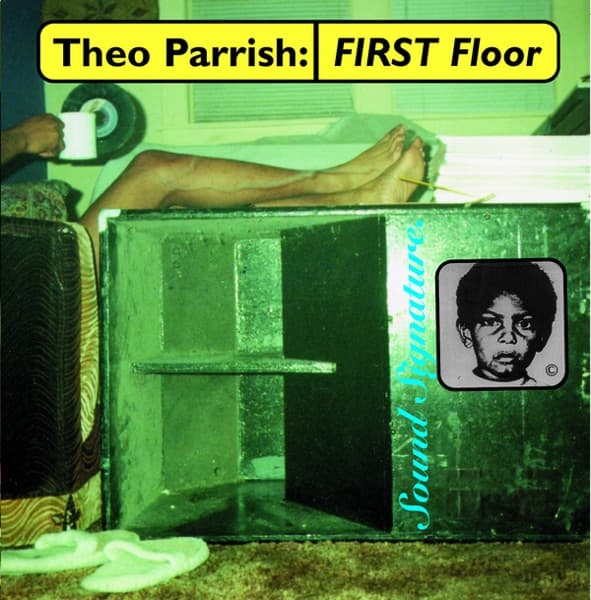
Parrish put out a handful of 12"s in the early to mid ’90s, but First Floor was his first full statement. It was originally released in 1998 as two separate vinyl EPs on the London label Peacefrog Recordings, and later compiled on CD that same year. The stylistic range is breathtaking, moving from jagged edits streaked with Ron Hardy-esque EQ abuse (“JB’s Edit”) to nervy, circular dancefloor heaters (“Paradise Architects”) to psychedelic tone poems (“Sky Walking”) to proto-footwork (“Love Is War for Miles”). Everything serves some percussive purpose, like the descending wah-wah’d guitar strokes connecting each kick in “Dark Patterns” or the handclaps repurposed as upbeat hi-hats in “First Floor Metaphor.” Parrish undergirds his mutating sample work with a steady pulse, or, maybe more accurately, a throb, that feels organic and sticky, as if each downbeat picks up more and more of the surrounding material.
The collected version of First Floor mostly maintains the sequencing of its two component parts and, over the 78-minute runtime, plays like a gradually unfolding DJ set. The first half, which mostly comes from Part 1, tends to run slower, while the back half, mostly sourced from Part 2, inches into quicker house tempos. Somehow, though, the early lento jams feel better suited to body-moving atmospheres than the more cerebral four-track suite that ends the record. There’s an urgency, an anxiety coursing throughout. The two-bar disco phrase anchoring “Sweet Sticky” repeats like a series of desperate follow-up questions, its syncopated claves like nervously shifting eyes. Parrish lets the seams show on “Love Is War for Miles,” the most tactile song in the tracklist. Layers of brass and percussion ricochet around the central kick, and the filtered, distorted piano stab sounds live and unquantized, as if he played it by hand on his sampler for nine minutes straight. Despite their slower pace, the first five songs seem ready to come apart at any second, perhaps mirroring the feeling of walking into the Warehouse, eager to temporarily erase the outside world with the shuffling of feet and gyrating of hips.
The CD and digital versions leave off “Only the Beginning,” the 11-minute stunner only found on vinyl copies of Part 1. Parrish loops a small section from the second verse of Luther Vandross’ “Never Too Much,” turning his assertion that “this is only the beginning” into a spiky, near-robotic rhythm. The bell-curve arrangement progresses sneakily, as Parrish drowns the Vandross sample in ever-multiplying layers of silvery synth and galloping bongos. Hi-hats begin to ratchet three minutes in; the keyboards modulate up an octave, upping the pressure on your poor, sedentary joints. By the time it blossoms into its full, swirling mass about halfway through, you’ll have a hard time keeping your hands out of the air.
The conventional idea is that First Floor is a prime—perhaps the prime—example of deep house, an offshoot of the genre that gained momentum in the mid-’80s. Many credit Mr. Fingers (an alias of Chicago house legend Larry Heard) with the first deep-house cut, “Mystery of Love.” It’s a little slower than most house music of the era and has a simple, earwormy chord progression that repeats until it takes on the characteristics of a Rorschach test. Heard would further develop this palette with “Can You Feel It,” which wrapped a squarewave melody in gentle, glowing pads and splashy TR-909 percussion. Deep house took on a jazzier, more sweeping vibe, better suited to chillout rooms than to clubs humid from body heat. These days, artists like Frank & Tony and Fred P have taken deep house even deeper, targeting high-end sound systems in listening bars and expensive over-the-ear headphones.
Parrish uses all of these hallmarks across First Floor, heavily sampling the warbling tones of Rhodes and Hammond keyboards, foregrounding melody, and mostly keeping his tempos at a brisk amble rather than a gallop. It’s warm and inviting; everything sounds as though it wereas recorded inside a thick winter coat. But though he comes from a house tradition, he’s usually reticent to apply any particular genre tag to his work. When asked by interviewers, he invokes the freedom of jazz as a guiding light. To him, each work is a sound sculpture, slabs of raw material from the vast Black music tradition that he chisels into form through repetition and a keen ear for frequency. The best tracks on First Floor, like “Paradise Architects,” evolve slowly, almost imperceptibly, as Parrish fades in new elements and skillfully adjusts the EQ to shift your attention without you realizing it. To hear him tell it, as he did in a 2005 Red Bull Music Academy lecture, these pieces are about pure feeling:
If you take away the magazines from dance music, if you can imagine what’s left, if you go back in time, you take away all of the sponsorship, you take away all of the things that make it a commodity, and you break it down to its essential form, you have nothing but pure experience among individuals. And if you can imagine that and then turn it into a language that’s spoken among you and shared among you, it’s something that you own.
In that regard, “Heal Yourself and Move,” First Floor’s penultimate jam, is its key. It’s deceptively simple, seemingly composed of nothing more than a gurgling keyboard line, mechanized shaker, sprightly snap, and, of course, the ever-present thump. The first three minutes melt into themselves, creating the kind of groove that lifts you from your chair without you noticing. Slowly but surely, the keyboard line doubles and squiggles around itself, and a voice, presumably Parrish’s, intones “Heal yourself and move” in one channel, “Let God be your guide” in the other. This is the spirit of rebellion and blanket of recognition that teenage Parrish felt when his dial was tuned to WBMX, and when he was surrounded by thousands of fellow Black kids at the Pavilion. “A party at that point in Chicago,” he told Red Bull Music Academy, “was bridging the gap from where you knew safety was, at home, to a communal experience.” In a city and a country and a history that deem some more worthy than others, there are curative properties in shaking that shit out on the dancefloor. To move is to revolt. To heal is revolutionary.