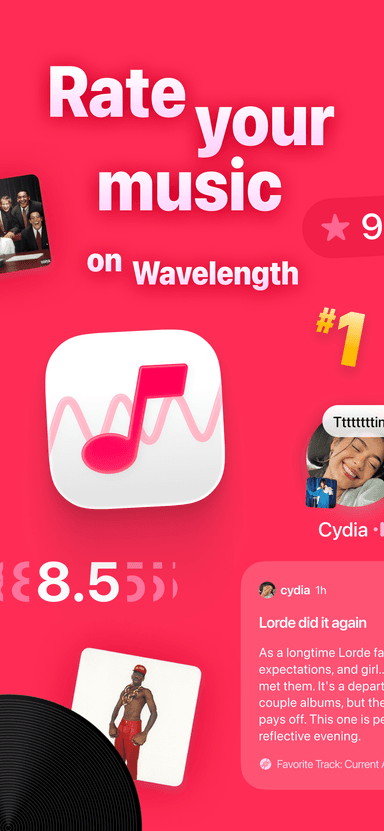
Wavelength
Wavelength
Rate and discover music with friends
pitchfork

pitchfork

Sheryl Crow

Sheryl Crow

Sheryl Crow (1996)

6.8/ 10

Each Sunday, Pitchfork takes an in-depth look at a significant album from the past, and any record not in our archives is eligible. Today, we revisit Sheryl Crow’s barnstorming second album, a collection of restless pop-rock anthems with something to prove.

Sheryl Crow’s self-produced second album begins with a woman scanning the sky for extraterrestrial life. “I swear they’re out there,” she sings, barreling down the highway in hot pursuit. It ends, 12 songs later, with a woman sneaking out of bed before the man beside her wakes up. “I’m just an ordinary woman/Slipping away,” she sings in her upper register, like she’s belting out a gospel standard.

The word “ordinary” is important here. Plenty of records follow a trajectory from the daily grind toward transcendence. Sheryl Crow traces a path from the stars down to earth. In its character-driven mosaic storytelling, we perceive a fractured country where kids buy guns at Walmart and women are murdered outside abortion clinics. Almost every character is alone. Even the happy ones are mysteriously, naggingly sad. The days stretch on, like open roads. If there’s a feel-good ending to “Ordinary Morning,” it’s that she got out at all, freed from anyone’s expectations, her future intact.

It takes a particular type of artist to make this all go down so easy and feel so light—so ordinary, as she might say. A multi-instrumentalist who often begins the writing process on bass guitar, Crow almost always situates her melodies around chiming major chords, bright tones she conjures with intuitive turns like a revving engine. You get the sense she heard “Start Me Up” at a formative age and aspired to live inside its opening riff, before the snare snaps in, for eternity.

Her voice, too, is a texture made for any weather, a type of denim that looked vintage from day one. No matter the existential angst or the extremes to which she pushes herself—those soulful howls in “Ordinary Morning,” or the shredded screech three-and-a-half minutes into “Love Is a Good Thing”—she never sounds less than completely comfortable. It feels good to sing her songs—and to sing them loud. It remains as true for drunken karaoke goers as it was for icons like Johnny CashPrince, and Bruce Springsteen, all of whom made songs from this album their own.

There is something elemental about the way Crow sees the world, and Sheryl Crow is her most timeless encapsulation of her vantage point. The song titles read like self-help books that have remained in print for decades: A Change Would Do You GoodEveryday Is a Winding RoadLove Is a Good Thing. Even if you aren’t one of the millions of people who bought this album on CD—it has never been issued on vinyl—you may know the songs just as well from endless radio play, car commercials, or the muffled speakers at department stores.

This is partially by design. Like the characters she sings about, Crow is woven into the everyday. Born in Kennett, Missouri in 1962, she grew up on the Beatlesthe Stones, and Fleetwood Mac: “The punk scene never made it out to the Midwest,” she joked during a 1996 interview with NME. At a time of newfound industry focus on regional scenes and independent artists, Crow reached for the masses. When Kurt Cobain gets namechecked early on the album, alongside a band of male rock stars who all died before their time, he’s as distant a myth as Elvis and John Lennon, or the UFOs she’s chasing in the preceding verses. “All I’ve seen just terrifies me,” she sings with a tinge of paranoia. “But I believe they’re coming back for me.” She rejected the romance of the tortured, fame-averse artist. She wanted to reach people, shamelessly, to hear her song reverberate through the world.

The first record she made never saw the light of day. After a decade of high-profile session work and a major role on Michael Jackson’s Bad Tour, she signed to a major label in the early ’90s and wound up with a glossy, trendy product that she begged the label not to release. The next album she made was named after the Tuesday Night Music Club, a Pasadena-based community of male musicians with whom Crow gathered to jam and co-write eventual hits like “Leaving Las Vegas,” “Strong Enough,” and “All I Wanna Do.” The fruits of those exercises—according to the liner notes, fueled by the simple desire “to experiment (musically, that is) and create”—went on to successfully launch Crow’s career, win a bunch of Grammys, and lose her nearly every friend she’d made. Producer Bill Bottrell told her, “If you only sold 10,000 copies, they’d love you.”

Tuesday Night Music Club sold millions. In the wake of its success, there were claims Crow had failed to properly credit her co-writers. There was tremendous backlash both in and outside her camp, talk of betrayal, dangerous amounts of drinking. Meanwhile the deceptively upbeat single “All I Wanna Do” reached a point of commercial ubiquity that began to haunt Crow, misconstruing her as a happy-go-lucky Los Angeles socialite. As bridges burned around her, she felt an increasing urgency to release something new and regain control of her life.

She and Bottrell got to work on some new songs in Pasadena, then decamped to New Orleans. It only took a day of recording for them to get into an argument and for Bottrell to abandon her. This is how Crow decided to produce the record herself. She continued working at Kingsway Studios in the French Quarter, where she had formed a close and lasting connection with engineer Trina Shoemaker. Together, they began working on a new set of songs she hoped would offer a clearer picture of who she was—songs that nobody else could take credit for.

Her ambition, as she told Billboard in 1996, was to make “a rural-sounding record—sort of Bobbie Gentry in the ’90s.” In an interview with Vivien Goldman for The Daily Telegraph, she elaborated that second part—“dragged into the ’90s.” It’s an apt word choice. You can almost hear the songs gathering dirt as they move along, catching fragments of the eras in between, resisting the flow of time as they move stubbornly forward. One of the first sounds on the record is a shovel being used for percussion; the last thing you hear is a noisy, tugging electric guitar solo that fades right on the verge of descending into chaos.

The whole record plays like a glitching patchwork quilt, flickering and fading as it unfolds. It’s self-titled, but it could just as easily be called The Sheryl Crow Songbook: an attempt to craft her own 13 entries in the American music lexicon. With the possible exception of “The Book,” whose chorus is more of a narrative Easter egg than something designed for road trip singalongs, nearly every song has an indelible hook. You get the sense, after the disputes of creative ownership that followed her debut, she would settle for nothing less: “My last record was heavily influenced by my writing from the standpoint of a woman with four guys around all the time,” she told the Telegraph. “I don’t feel like the same person anymore.”

She expressed this change through songs that refused to be misunderstood—an impulse that led to her first attempts at protest songs. On her previous album, there was “The Na-Na Song,” a “Loser”-style slacker rap that culminates in a jokey allusion to her experience of sexual harassment at the hands of Michael Jackson’s manager. “Frank DiLeo’s dong/Maybe if I’d let him I’d have a hit song,” she chants before the final iteration of the wordless chorus.

Now she trafficked in the type of songwriting that gets your record banned by big-box stores: Walmart, a dominant retailer during the height of the CD boom, refused to sell Sheryl Crow due to a lyric about gun violence in “Love Is a Good Thing.” The decision became so divisive that local radio stations banded together to sell the album themselves, in Walmart parking lots. (“Boo for Walmart or boo for me?” Crow once asked an audience after introducing it in concert as “The Walmart Song.”)

And then there was “Redemption Day,” a folk song inspired by Crow’s experience in Bosnia and her expanding perspective on the motives behind American intervention abroad. You can hear her ambition in her word choice—“Come leaders, come you men of great,” she sings, adopting early ’60s Dylan cadence—but it’s also in her performance. When she sings “freedom” in the closing line she repeats it a few times, allowing the word to be a conduit for contemplation and catharsis.

She brings this type of nuance to each song, and the ones centered on matters of the heart feel just as urgent and impassioned. There’s a reason why “If It Makes You Happy” is the track from the album that’s actually become a standard. Even Crow, who co-wrote the song with Jeff Trott, was overwhelmed by how many different ways she could find to accompany its lyrics: haunted and Lynchian, funk or punk, country or rock. What they landed on is maybe her defining performance: steady and simple, at 95 BPM, grinding through each verse before exploding in the chorus. “I’m not the kind of girl you take home,” Crow sings, and the song never quite comes to rest either. The wheels are always rolling.

No matter the highs and lows that followed, Crow had situated herself in the greater consciousness. This is how she fought the establishment and, in turn, became the establishment. As the album went multi-platinum and elevated her star far above the one-hit wonder or cautionary tale she’d feared becoming, she swiftly began remodeling herself as a legacy artist: a self-possessed, old-school singer-songwriter, already disillusioned with the industry and uninterested in catering to pop trends. Next up was the theme song for a James Bond movie; then a dark, triumphant follow-up that featured, among her own material, a brand new, unreleased Dylan composition; then a live album recorded in Central Park, where she welcomed childhood heroes Stevie NicksKeith Richards, and Chrissie Hynde onstage beside her.

And the decade wasn’t even over yet. Where could she possibly go next? In a ’97 interview with Charlie Rose, after discussing her brief dalliance with acting, the two have a jokey conversation that goes like this:

Rose: Let’s figure out something for you to do. We need an obsession.Crow: Bridge? Knitting, perhaps?Rose: How about your own label?Crow: Actually, I’m thinking about doing that. I’ve talked about it with my manager.

They go on for a bit, suggesting names: “Cranky Old Lady Music,” Crow offers, and then: “Do It Yourself Records.” Rose changes the subject—“Is there anything you desperately, desperately want? Children?”—but there is something interesting about Crow aligning herself with DIY culture: a burgeoning scene at the time that ran directly against all her usual metrics of success. Her seeming commercial indestructibility, combined with her proudly boomer taste and earnestly optimistic political outlook, made her a perfect contrast to gendered, Gen X notions of cool and authenticity, a dissonance she increasingly noticed when she confronted the press. After an exhausting interview for Q in 1998—“Did you hear the rumor that you are a heroin addict?” “Do you think you are attractive?” “Can you be a ruthless bitch?”—the interview concludes thusly:

Q: Do you have anything to declare?A: I’m sick of being a woman. That’s what I want to declare.

[Sheryl Crow](https://pitchfork.com/artists/13428-sheryl-crow/)’s self-produced second album begins with a woman scanning the sky for extraterrestrial life. “I swear they’re out there,” she sings, barreling down the highway in hot pursuit. It ends, 12 songs later, with a woman sneaking out of bed before the man beside her wakes up. “I’m just an ordinary woman/Slipping away,” she sings in her upper register, like she’s belting out a gospel standard. The word “ordinary” is important here. Plenty of records follow a trajectory from the daily grind toward transcendence. *Sheryl Crow* traces a path from the stars down to earth. In its character-driven mosaic storytelling, we perceive a fractured country where kids buy guns at Walmart and women are murdered outside abortion clinics. Almost every character is alone. Even the happy ones are mysteriously, naggingly sad. The days stretch on, like open roads. If there’s a feel-good ending to “Ordinary Morning,” it’s that she got out at all, freed from anyone’s expectations, her future intact. It takes a particular type of artist to make this all go down so easy and feel so light—so ordinary, as she might say. A multi-instrumentalist who often begins the writing process on bass guitar, Crow almost always situates her melodies around chiming major chords, bright tones she conjures with intuitive turns like a revving engine. You get the sense she heard “[Start Me Up](https://www.youtube.com/watch?v=7JR10AThY8M)” at a formative age and aspired to live inside its opening riff, before the snare snaps in, for eternity. Her voice, too, is a texture made for any weather, a type of denim that looked vintage from day one. No matter the existential angst or the extremes to which she pushes herself—those soulful howls in “Ordinary Morning,” or the shredded screech three-and-a-half minutes into “Love Is a Good Thing”—she never sounds less than completely comfortable. It feels good to sing her songs—and to sing them loud. It remains as true for drunken karaoke goers as it was for icons like [Johnny Cash](https://pitchfork.com/artists/696-johnny-cash/), [Prince](https://pitchfork.com/artists/3397-prince/), and [Bruce Springsteen](https://pitchfork.com/artists/4053-bruce-springsteen/), all of whom made songs from this album their own. There is something elemental about the way Crow sees the world, and *Sheryl Crow* is her most timeless encapsulation of her vantage point. The song titles read like self-help books that have remained in print for decades: *A Change Would Do You Good*. *Everyday Is a Winding Road*. *Love Is a Good Thing*. Even if you aren’t one of the millions of people who bought this album on CD—it has never been issued on vinyl—you may know the songs just as well from endless radio play, car commercials, or the muffled speakers at department stores. This is partially by design. Like the characters she sings about, Crow is woven into the everyday. Born in Kennett, Missouri in 1962, she grew up on [the Beatles](https://pitchfork.com/artists/546-the-beatles/), [the Stones](https://pitchfork.com/artists/8275-the-rolling-stones/), and [Fleetwood Mac](https://pitchfork.com/artists/6026-fleetwood-mac/): “The punk scene never made it out to the Midwest,” she joked during a 1996 interview with *NME*. At a time of newfound industry focus on regional scenes and independent artists, Crow reached for the masses. When Kurt Cobain gets namechecked early on the album, alongside a band of male rock stars who all died before their time, he’s as distant a myth as Elvis and John Lennon, or the UFOs she’s chasing in the preceding verses. “All I’ve seen just terrifies me,” she sings with a tinge of paranoia. “But I believe they’re coming back for me.” She rejected the romance of the tortured, fame-averse artist. She wanted to reach people, shamelessly, to hear her song reverberate through the world. The first record she made never saw the light of day. After a decade of high-profile session work and a [major role](https://www.youtube.com/watch?v=I5s1Vv_qvtw) on [Michael Jackson](https://pitchfork.com/artists/2237-michael-jackson/)’s Bad Tour, she signed to a major label in the early ’90s and wound up with a glossy, trendy product that she begged the label not to release. The next album she made was named after the Tuesday Night Music Club, a Pasadena-based community of male musicians with whom Crow gathered to jam and co-write eventual hits like “Leaving Las Vegas,” “Strong Enough,” and “All I Wanna Do.” The fruits of those exercises—according to the liner notes, fueled by the simple desire “to experiment (musically, that is) and create”—went on to successfully launch Crow’s career, win a bunch of Grammys, and lose her nearly every friend she’d made. Producer Bill Bottrell told her, “If you only sold 10,000 copies, they’d love you.” *Tuesday Night Music Club* sold millions. In the wake of its success, there were claims Crow had failed to properly credit her co-writers. There was tremendous backlash both in and outside her camp, talk of betrayal, dangerous amounts of drinking. Meanwhile the deceptively upbeat single “All I Wanna Do” reached a point of commercial ubiquity that began to haunt Crow, misconstruing her as a happy-go-lucky Los Angeles socialite. As bridges burned around her, she felt an increasing urgency to release something new and regain control of her life. She and Bottrell got to work on some new songs in Pasadena, then decamped to New Orleans. It only took a day of recording for them to get into an argument and for Bottrell to abandon her. This is how Crow decided to produce the record herself. She continued working at Kingsway Studios in the French Quarter, where she had formed a close and lasting connection with engineer Trina Shoemaker. Together, they began working on a new set of songs she hoped would offer a clearer picture of who she was—songs that nobody else could take credit for. Her ambition, as she told *Billboard* in 1996, was to make “a rural-sounding record—sort of [Bobbie Gentry](https://pitchfork.com/artists/1701-bobbie-gentry/) in the ’90s.” In an interview with Vivien Goldman for *The Daily Telegraph*, she elaborated that second part—“dragged into the ’90s.” It’s an apt word choice. You can almost hear the songs gathering dirt as they move along, catching fragments of the eras in between, resisting the flow of time as they move stubbornly forward. One of the first sounds on the record is a shovel being used for percussion; the last thing you hear is a noisy, tugging electric guitar solo that fades right on the verge of descending into chaos. The whole record plays like a glitching patchwork quilt, flickering and fading as it unfolds. It’s self-titled, but it could just as easily be called *The Sheryl Crow Songbook*: an attempt to craft her own 13 entries in the American music lexicon. With the possible exception of “The Book,” whose chorus is more of a narrative Easter egg than something designed for road trip singalongs, nearly every song has an indelible hook. You get the sense, after the disputes of creative ownership that followed her debut, she would settle for nothing less: “My last record was heavily influenced by my writing from the standpoint of a woman with four guys around all the time,” she told the *Telegraph*. “I don’t feel like the same person anymore.” She expressed this change through songs that refused to be misunderstood—an impulse that led to her first attempts at protest songs. On her previous album, there was “The Na-Na Song,” a “[Loser](https://www.youtube.com/watch?v=YgSPaXgAdzE)”-style slacker rap that culminates in a jokey allusion to her experience of sexual harassment at the hands of Michael Jackson’s manager. “Frank DiLeo’s dong/Maybe if I’d let him I’d have a hit song,” she chants before the final iteration of the wordless chorus. Now she trafficked in the type of songwriting that gets your record banned by big-box stores: Walmart, a dominant retailer during the height of the CD boom, refused to sell *Sheryl Crow* due to a lyric about gun violence in “Love Is a Good Thing.” The decision became so divisive that local radio stations banded together to sell the album themselves, in Walmart parking lots. (“Boo for Walmart or boo for me?” Crow once asked an audience after introducing it in concert as “The Walmart Song.”) And then there was “Redemption Day,” a folk song inspired by Crow’s experience in Bosnia and her expanding perspective on the motives behind American intervention abroad. You can hear her ambition in her word choice—“Come leaders, come you men of great,” she sings, adopting early ’60s [Dylan](https://pitchfork.com/artists/1177-bob-dylan/) cadence—but it’s also in her performance. When she sings “freedom” in the closing line she repeats it a few times, allowing the word to be a conduit for contemplation and catharsis. She brings this type of nuance to each song, and the ones centered on matters of the heart feel just as urgent and impassioned. There’s a reason why “If It Makes You Happy” is the track from the album that’s actually become a standard. Even Crow, who co-wrote the song with Jeff Trott, was overwhelmed by how many different ways she could find to accompany its lyrics: haunted and Lynchian, funk or punk, country or rock. What they landed on is maybe her defining performance: steady and simple, at 95 BPM, grinding through each verse before exploding in the chorus. “I’m not the kind of girl you take home,” Crow sings, and the song never quite comes to rest either. The wheels are always rolling. No matter the highs and lows that followed, Crow had situated herself in the greater consciousness. This is how she fought the establishment and, in turn, *became* the establishment. As the album went multi-platinum and elevated her star far above the one-hit wonder or cautionary tale she’d feared becoming, she swiftly began remodeling herself as a legacy artist: a self-possessed, old-school singer-songwriter, already disillusioned with the industry and uninterested in catering to pop trends. Next up was the theme song for a James Bond movie; then a dark, triumphant follow-up that featured, among her own material, a brand new, unreleased Dylan composition; then a live album recorded in Central Park, where she welcomed childhood heroes [Stevie Nicks](https://pitchfork.com/artists/23583-stevie-nicks/), [Keith Richards](https://pitchfork.com/artists/15997-keith-richards/), and [Chrissie Hynde](https://pitchfork.com/artists/8008-chrissie-hynde/) onstage beside her. And the decade wasn’t even over yet. Where could she possibly go next? In a ’97 interview with Charlie Rose, after discussing her brief dalliance with acting, the two have a jokey conversation that goes like this: **Rose:** Let’s figure out something for you to do. We need an *obsession*.**Crow:** Bridge? Knitting, perhaps?**Rose:** How about your own label?**Crow:** Actually, I’m thinking about doing that. I’ve talked about it with my manager. They go on for a bit, suggesting names: “Cranky Old Lady Music,” Crow offers, and then: “Do It Yourself Records.” Rose changes the subject—“Is there anything you desperately, desperately want? Children?”—but there is something interesting about Crow aligning herself with DIY culture: a burgeoning scene at the time that ran directly against all her usual metrics of success. Her seeming commercial indestructibility, combined with her proudly boomer taste and earnestly optimistic political outlook, made her a perfect contrast to gendered, Gen X notions of cool and authenticity, a dissonance she increasingly noticed when she confronted the press. After an exhausting interview for *Q* in 1998—“Did you hear the rumor that you are a heroin addict?” “Do you think you are attractive?” “Can you be a ruthless bitch?”—the interview concludes thusly: **Q:** Do you have anything to declare?**A:** I’m sick of being a woman. That’s what I want to declare.

Rate music on Wavelength

Download Wavelength to share your own reviews and see what your friends think.

Rate music on Wavelength

A free place to rate albums and write reviews with friends. Letterboxd-style, for music.

Download on the App Store