
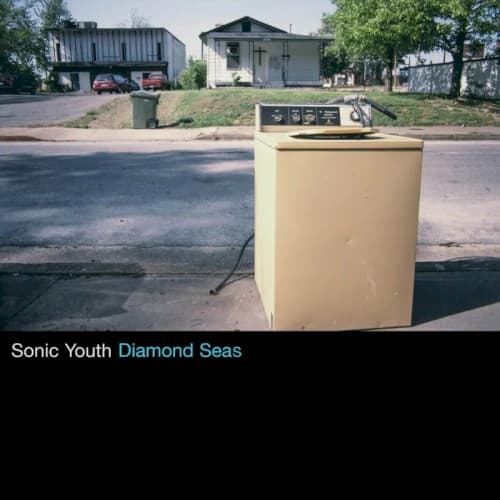
Back in the mid-1990s, when Sonic Youth started performing a new song called “The Diamond Sea,” whoever wrote out their setlists would etch the phrase “new neil-esque” next to the title, presumably in reference to Neil Young. This new 20-minute epic was the band’s Crazy Horse moment, their idea of a rock anthem that starts with a tuneful, melancholy song and then proceeds to deconstruct it with loud report. The studio version, recorded down in Memphis between trips to Payne’s Bar-B-Q, opens with a guitar that sounds almost eerily humanoid in its yoiyoiyoiyoiyoiy tone. Then, Thurston Moore sets the scene with one of the band’s best lines: “Time takes its crazy toll.” (“Neil-esque,” indeed.) After three verse-chorus repetitions, the quartet stop the song cold and set off in a new direction, churning out pure noise even as drummer Steve Shelley keeps everyone anchored. Gradually, they find their way through the din and dissonance back to the song, and when they hit that central riff again, it makes for one of the most satisfying moments in the band’s estimable catalog. Soon, the song unravels again, as though this cycle might repeat forever: noise overtaking song overtaking noise, ugliness overtaking beauty overtaking ugliness, until you can’t distinguish between them.
“The Diamond Sea” was, remarkably, the first single from Sonic Youth’s 1995 album Washing Machine, and because nobody was going to play a 20-minute song on the radio, the band created a five-minute edit that’s shallow shoals compared to the original’s Mariana Trench. They also released a 25-minute version, as though compensating for the truncated one. It’s not the longest song in the band’s catalog, but “The Diamond Sea” might be the most mutable. Listening to it 30 years later, the song still seems to be constantly changing, always shifting, never quite settling into itself. It should be one of their most popular and beloved tracks, right up there with “Teenage Riot” and “Kool Thing,” but they stopped playing it in 1996 and it remains a fairly deep cut.
All of that makes the song ideal for the plunderphonic treatment. The band commissioned John Oswald, who coined that term back in 1985, to reconstruct “Diamond Sea” for a new vinyl-only release. He used more than 30 live recordings, which together comprise more than seven hours of material. And he deployed a very similar process to the one he used to turn more than 100 recordings of the Grateful Dead’s “Dark Star” into the triple album Grayfolded: listening to every track all at once—surely a heady experience—then whittling, filtering, synchronizing, mixing, remixing, and building back up. Eventually, he landed on two new iterations of “The Diamond Sea.” On the A side of this release is one version Frankensteined from 1995 performances, and on the B side is one made from 1996 performances (although he supplemented both with material from the studio original). Both of these “Seas” are the same length—20 minutes and 44 seconds—and sound very much like live cuts, complete with crowd noise, stage banter, cries of “Free Tibet!” and a dedication to Yoko Ono. Oswald brings something alien and disorienting to the surface of the song, but also makes it sound wild and beautiful and poignant.
Sonic Youth spent the summer of 1995 headlining Lollapalooza and performing for their largest crowds, and they played “The Diamond Sea” on all 29 dates. Oswald only uses four of those recordings, but it still might explain why the 1995 version sounds so big and triumphant, with a strut to its riffing and a bit of cockiness in its dissonance. Listening to this version feels a little like being at a festival and hearing Sonic Youth from both two stages simultaneously. Here, the song more than matches its neil-esque aspirations, testing and teasing the audience’s endurance, so that when they hit that key riff again halfway through, the crowds—all of them—go nuts. It’s a record of the band at the height of its powers, turning its headlining slot into an event.
Sonic Youth stayed on the road throughout most of 1996, and that year’s version of “The Diamond Sea” sounds roughshod, harried, and precarious. There’s less pre-song banter, and the crowd noise becomes just more noise. The song never quite clicks together, especially on the first verse: Moore rushes some lines and draws others out, sounding at odds with the rest of the band. But the effect is unexpectedly humanizing. The plunderphonic process makes it impossible to tell if this is a mistake or a creative decision Moore made, or one Oswald made, or simply serendipity. Moore sounds beleaguered at the outset, which makes the next 20 minutes particularly fraught and precarious. Even the song’s big moment—the climactic return—is muted and tentative here, as what should be the triumphant riff stalls out before its final note. It’s the sound of a band throwing themselves into the depths and not knowing if they’ll ever surface.
Diamond Seas presents plunderphonics as a form of divination, akin to spirit photography or automatic writing. Oswald helps us see what is not readily visible—the tension of melody, the catharsis of noise. There certainly seem to be apparitions in this music, some presence apart from the four musicians and the throngs of fans, which is intensified by the visceral collision of so many sounds. Because Sonic Youth has been broken up for over a decade, even the band itself is a kind of ghost here. After a series of historical reissues, this curious release gives us Sonic Youth in something of present tense. They’re still changing things up from one night to the next, still figuring out how to make their own songs new again—still reminding us how time takes its crazy toll.