

Sure, you could look at the birth of Lollapalooza in 1991 as the tipping point when American counterculture turned into big business. But you can’t deny, on those early tours, a lot of insane shit went down. To date, it remains the only festival where you could watch Flea drink Jim Rose’s bile, Eddie Vedder dangle precariously from 30-foot-high scaffolding, and Rage Against the Machine exercise a less-rock/more-cock policy. Ultimately, there were limits to this lawlessness—as one band discovered, it was, in fact, possible to be too weird for Lollapalooza.
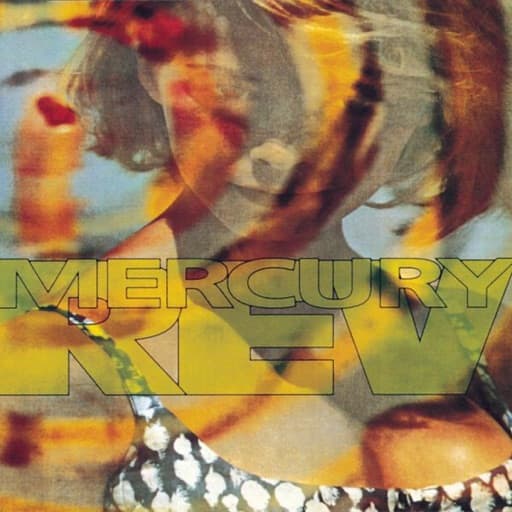
On June 26, 1993, Mercury Rev appeared on Lolla’s second stage at the Fiddler’s Green Amphitheatre in Greenwood Village, Colorado, slotted between “a guy juggling chainsaws” and Tool. Like most of their sets from that era, their performance climaxed with an extended jam on “Very Sleepy Rivers,” the sinister, psychedelic hallucination that closes their 1991 debut album, Yerself Is Steam. But where the song normally provided the band with an opportunity to zone out and surrender to the squall for 15 minutes, on this day, their noise bath was rudely interrupted: After their onstage volume level suddenly dipped, the band noticed their soundman being violently pulled away from the board by security, bringing the set to an abrupt end.
As it turns out, the mayor of Denver was strolling the Lollapalooza grounds and stumbled upon Mercury Rev’s set. He was so sufficiently traumatized by what he heard, he demanded an immediate shutdown. In his estimation, the band sounded “like a bus idling out of control,” and unbeknownst to him, the mayor was actually offering up an astute piece of music criticism. In their formative years, Mercury Rev really did sound like a careening bus headed towards a fiery crash—one where half the people on board were frantically fighting each other for control of the wheel, and the other half were in the back obliviously singing nursery rhymes as the whole bucket of bolts went up in flames.
Hindsight positions Mercury Rev as rare American entrants in the early-’90s shoegaze fuzzbox wars, a claim supported by UK tours with Ride and My Bloody Valentine. But if shoegaze was a collision of melody and noise, both of those elements were generally tuned to the same psychedelic frequency. What Mercury Rev captured on Yerself Is Steam was less a melding of disparate sounds than a battle royale of oppositional ideologies: order and anarchy, ecstasy and terror, purity and perversion.
While Mercury Rev would later become synonymous with the bucolic Catskills area, their saga begins a couple hundred miles west in Buffalo. When the band formed in the late-’80s, the city had become another hollowed-out notch on America’s Rust Belt, ravaged by an all-too-familiar recessionary cocktail of shrinking manufacturing industries, mass unemployment, and population decline, not to mention punishing winters and an inordinate amount of fires. (For a certain generation, no day was complete without hearing Irv Weinstein of Eyewitness News announce another five-alarm blaze in Cheektowaga.) Whatever local bands achieved any degree of national renown at the time—be it the trashy early iteration of the Goo Goo Dolls or fledgling death-metal deities Cannibal Corpse—reflected the city’s reputation as a harsh, unforgiving place to exist.
For much of the 1980s, the future members of Mercury Rev seemed headed down a similar path. In the first half of the decade, a teenaged Sean “Grasshopper” Mackowiak played drums in local punk band the People’s Front, whose peak achievement (according to a fan site) was having their cassette reviewed by Maximum RockNRoll. By 1987, Mackowiak was a media studies major at SUNY Buffalo and playing bass alongside a quartet of fellow students in Shady Crady, the sort of weirdo indie-rock band that would fill the first-of-three local-opener slot when Sonic Youth rolled through Buffalo—though the fact they featured a flautist (Suzanne Thorpe) and a lead singer (David Baker) who messed around on a Casio SK-1 suggested a certain willingness to subvert punk orthodoxy.
Playing guitar in Shady Crady was Mackowiak’s close friend Jonathan Donahue, whose side hustle booking gigs for SUNY’s student union put him in the orbit of Oklahoma psych-rock misfits the Flaming Lips, who opened for Throwing Muses at SUNY in 1987. After dropping out to serve as their roadie for a few years—which, in the Lips’ case, largely meant operating their smoke and bubble machines—Donahue became the band’s full-fledged second guitarist in time for 1990’s In a Priest Driven Ambulance, the album that dramatically transformed the Lips from acid-punk pranksters into cosmic-pop craftsmen.
As a child growing up in the Catskills, Donahue wasn’t exposed to the record-collector canon; his parents raised him on a steady diet of classical music, Broadway soundtracks, and variety-show country tunes. “I never listened to Pet Sounds,” he admitted to Magnet’s Corey DuBrowa in 2015, “but I liked Sons of the Pioneers.” That music’s sense of wonder and grandeur would stay with Donahue even as he cut his teeth in the grimy late-’80s American underground. Lips leader Wayne Coyne has largely attributed Priest’s artistic breakthroughs to Donahue’s kid-brother energy, and his ability to dream big on a low budget. “He had this little cassette 4-track,” Coyne recalled to Rolling Stone, “and we bought some crappy little microphones and used our guitar effects to experiment with how we would record. He brought that whole thing into it… If Jonathan hadn’t jumped in and encouraged us and added his abilities to ours, I think little by little we would have been frustrated.”
In a Priest Driven Ambulance was also the first album to feature the words “Produced by Dave Fridmann” in the credits, long before that phrase became a shorthand for orchestral-indie extravagance and platinum-plated alt-rock. At the time, Fridmann was studying music production at SUNY Fredonia, about an hour south of Buffalo. A childhood friend of Shady Crady drummer Mike Huber, Fridmann had helped produce a demo for that band at the campus’ studio in 1988, and though that tape never yielded a record deal, the connection would ripple out in the years to come. Around the same time that Donahue was welcoming Fridmann into the Lips’ circle, he was also, he was also enlisting the producer for a new project he was developing with fellow Shady Crady exiles Mackowiak, Baker, and Thorpe.
A lot of experimental music is described as bands making soundtracks for movies that don’t exist. Yerself Is Steam began as soundtracks to actual movies, composed by a band that didn’t really exist. The nascent Mercury Rev started making music together less with the intent of playing gigs than concocting musical scores, be it for student films showing in local galleries, or the nature documentaries they’d put on the TV while they improvised. Limited access to resources and equipment meant they had to get extra-industrious. As recounted to Magnet, Donahue played his guitar through a jury-rigged TV-set speaker; songs were recorded onto answering machine cassettes.
While recording with the Lips, Donahue workshopped some embryonic versions of future Mercury Rev songs, and it was already clear to Coyne and co. that their new guitarist would inevitably need to focus on his own project. (Donahue’s tenure in the Lips would last for just one more record, 1992’s Hit to Death in the Future Head.) In Mercury Rev’s case, the term “project” could be applied in the literal academic sense: Fridmann agreed to produce their recordings as part of his course-work, allowing Donahue and co. to access the SUNY Fredonia studios in off-hours at bargain-basement rates. Fridmann eventually contributed enough bass parts—and household-appliance sound effects—to become an official member of the group, while drummer Jimy Chambers joined late in the process to effectively serve as the frame around Mercury Rev’s musical splatter. (As Chambers told Magnet: “What you hear is me not knowing what to do and being really uncomfortable.”)
Where the Lips were clearly a product of classic rock, psychedelic, and punk traditions, Mercury Rev were built atop a philosophical foundation more than a musical one. At SUNY, Donahue studied under Robert Creeley, the celebrated post-modernist poet whose minimalist, evocative work often embraced the non-linear logic of jazz. Mackowiak studied under avant-garde filmmaker Paul Sharits and composer Tony Conrad, whose early-’60s drone explorations would lay the groundwork for the Velvet Underground, and whose classroom teachings instilled Mercury Rev with new perspectives on creating art. “One of the first assignments he had the class do was to pick a film or piece of music that we personally strongly disliked, and write about it in a very positive way,” Mackowiak would reminisce to NPR following Conrad’s 2016 passing. “Then the next week, we were to do the opposite, pick something we liked and totally trash it. That was an amazing exercise in opening the mind up to questioning: ‘What is high-brow? What is low-brow? What is good art and what is bad art?’… the distinctions between folk art/folk music and the ‘classics’ were erased.” Baker, meanwhile, didn’t even think in musical terms at all. “It’s more emotion that influences us than music,” he would tell the L.A. Times in 1993. “An influence could be a car backfiring, chocolate, sex, or deprivation of sex.”
In eight songs, Yerself Is Steam uncorks a flood of sounds and sensations, resulting in an awe-inspiring, nerve-racking experience, floating in the liminal space between childhood innocence and adult anxieties. That volatility is reflected in the dynamic between the group’s two vocalists: In Baker, you had a singer who sounded like a malfunctioning tape recorder, randomly pitch-shifting between voice-cracking glee and gothic gloom, sometimes in the span of a single line; in Donahue, you had a stoner crooner who could chase the dark clouds away with his starry-eyed serenades, while tapping deep veins of sorrow. When their voices appear together, they’re not so much playing off each other as fronting two completely different bands in their minds, making a song like “Syringe Mouth” sound like a kindergarten circle-time sing-along being held in the middle of a Butthole Surfers concert.
Given the group’s piecemeal origins, the members of Mercury Rev were always quick to downplay any grand design on their part. Speaking about the band’s creative process to the L.A. Times, Baker said, “We’re not trying to make radio-friendly hits and if there are those song structures there, well, it’s not intentional.” No song advertised that anti-pop manifesto as proudly as “Very Sleepy Rivers,” where Baker freestyles madcap Dr. Seuss-like couplets (“I sensed a new scent, so innocent and bent/I sense a new scent that's innocent and spent”) in his creepiest register, while the band’s seasick groove oozes and churns for over 12 unsettling minutes. But even at its most confrontational, Yerself Is Steam is ultimately a testament to Mercury Rev’s innate melodic fortitude.
The album’s totemic opening track, “Chasing a Bee,” is a study of contrasts upon contrasts: its acoustic refrain suggests a certain campfire tranquility, yet Baker recites the verses as if they were koans: (“It’s not as easy as it may seem/Remember that yerself is steam”) with the queasy discomfort of someone who really needs to get to the bathroom. But when Donahue steps in to deliver the chorus, his blissed-out vocal is answered by a punishing blast of distortion—and even that can’t prepare you for what occurs at the 3:07 mark, when he and Mackowiak unleash a discombobulating shock of feedback that feels like Earth splitting open. (That sudden intrusion is reflective of the album’s combative tug-of-war mixing process, where the final product was often determined by which band member got their fingers on the faders last.) And yet the song’s calming choral hook ultimately sticks the landing, with Thorpe’s flute melody serving as the safety cushion.
Where many shoegaze bands used noise to corrupt or outright obliterate their pop sensibilities, Mercury Rev seemed to treat each song like a laboratory test to see what their core melodies could withstand. The nine-minute fuzz-covered stunner “Frittering” sounds like a mid-’70s Neil Young ballad slowly fading out of broadcast range on a late-night drive. But rather than obscure its emotional intent, the static-soaked production amplifies the song’s melancholy and strung-out confusion. And even the album’s unwieldy, cardiac-arresting centerpiece, “Sweet Oddysee of a Cancer Cell T’ Center of Yer Heart,” demonstrates a fine balance of chaos and craft, by reimagining Sonic Youth’s “Expressway to Yr Skull” as a Wagnerian symphony. If Mercury Rev weren’t yet at the point where they could afford a string section, they could certainly approximate the thunderous power and cavernous sound of a live orchestra.
As far out as Mercury Rev ventured sonically, their music was always anchored by a strong sense of place. The album’s most compact (and Lips-like) psych-pop statement, “Coney Island Cyclone,” is the first entry in what would become a long-standing Mercury Rev tradition of incorporating New York State scenery. And while “Blue and Black” makes no explicit reference to its setting, it is undoubtedly the most vivid song ever made about surviving a Buffalo winter. “It’s so cold outside,” Baker intones in an impossibly low voice, while the huff and puff of a percolating coffee machine animates each frost-covered breath. But the introduction of a glistening piano melody, dreamy guitar swirls, and blood-pumping percussion magically transforms this greyscale scene into a Technicolor fantasia, crystallizing that moment when you peek out from your parka and notice just how beautiful all the snow looks in the moonlight.
Mercury Rev could afford to be hyper-local in their approach because there was never any expectation that these songs would find an audience beyond upstate New York. But the band found a sympathetic ear in the UK micro-indie label Mint, who released the album in May 1991 and was able to get it in the hands of British music-press tastemakers like Simon Reynolds and Chris Roberts. Six months before Nirvana’s Nevermind turned the underground upside down, the UK hype machine was trumpeting Mercury Rev as American indie rock’s next great saviors. And that’s not because they saw them as potential rock stars, but as the “alternative to the alternative”—torch-bearers for a transgressive aesthetic that seemed to be dissipating as leading freak-scene luminaries like Sonic Youth, Dinosaur Jr., and Butthole Surfers were trading up to major labels and streamlining their sound. In a move that seems unfathomable in today’s depressed music-media economy, Melody Maker actually flew Roberts to Fredonia to see Mercury Rev perform—despite the fact the band had yet to perform a single show, and therefore had to swiftly arrange a local bar gig for their British visitor.
By summer, the overseas buzz around the band was loud enough to earn them a place at the Reading Festival for just their third-ever gig. (Improbably, their fourth gig was an opening slot for Bob Dylan at Yale University.) On stage, Mercury Rev were even more unhinged than they were on record; both physically and behaviorally, Baker was the antithesis of the typical rock frontman, a convulsive human conduit for the band’s live-wire energy. But once the post-Nevermind hysteria overwhelmed the music industry in early ’92, major labels could look at a band this strange with dollar signs in their eyes. After their first North American distributor, Rough Trade, went belly up, Mercury Rev signed a deal with Columbia to properly release Yerself Is Steam in the U.S., where CD editions came appended with the bonus non-album single “Car Wash Hair,” an atypical orchestral-pop delight that let a radiant dose of summery sunshine into Mercury Rev’s forbidding Buffalo-spawned sound-world.
With its chirpy trumpets and beautifully sundazed melody, “Car Wash Hair” pointed to a bright future for Mercury Rev—but it would take them many years to get there. Despite all the rave reviews and Peel Session invites, Mercury Rev’s sound was ultimately too proggy in scope and too violent in execution to put up Nirvana numbers. Extensive touring behind Yerself Is Steam and its equally frazzled and bedazzled 1993 follow-up, Boces, took a heavy psychological toll on a group that never intended to play together outside the studio, leading to some infamously acrimonious incidents that rival Oasis and the Brian Jonestown Massacre. The tale of Baker trying to gouge out Mackowiak’s eyes with a spoon on a transatlantic flight—leading to a ban from Virgin Airways—may not be entirely true, yet it was easy enough to believe it was. As Donahue is fond of saying, “We’re like the Doors biography, in reverse—all of our weirdness happened first, and then we got sorted out and found some kind of sense in it.”