
Navigating conditioning, zeitgeists, and cultural nudges toward alpha-ism and sensitivity, Tyler has landed on both sides, exemplifying rap at its brashest (his first two albums, 2009’s Bastard and 2011’s Goblin) while also voicing heartbreak, an earnest desire for love, and commitments to personal growth (2017’s Flower Boy, 2019’s Igor).
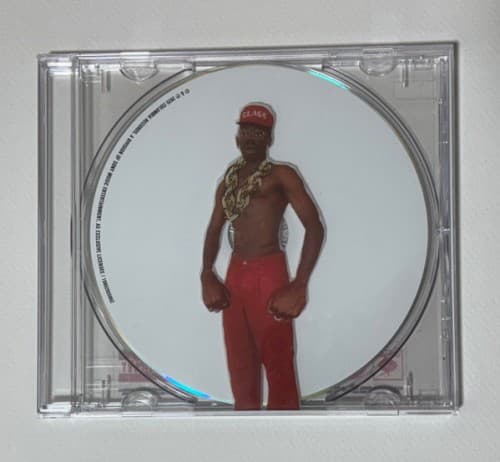
With his latest album, DON’T TAP THE GLASS, he continues to seek balance between warring impulses (as he did previously with 2021’s Call Me If You Get Lost). While his solution is alternation more than integration, the album, one of his shortest sets at approximately 28 minutes, does succinctly illustrate his range, in terms of emotions, identity, and outlook.
With his intro track, “Big Poe”, he adds another character to his dramatis personae; that said, he’s lyrically in line with earlier “I don’t give fucks” forays. Big Poe is “married to the game forty carats in the rings” and doesn’t “trust white people with dreadlocks”. Ironically, Tyler’s cadence brings to mind Blood Sugar Sex Magik-era Anthony Kiedis. The hyperbole is abundant as is the stock machismo which, at this point in hip-hop history, is hard to regard as anything but satirical in tone. Sonically, the piece is thrillingly cacophonous, overflowing with brash synths and aggressive beats.
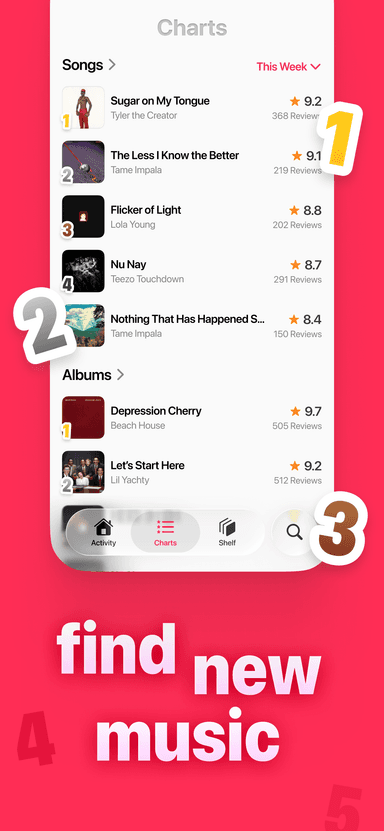
“Sugar on My Tongue”, too, is fuzzy, loud, and raucous, as
Tyler offers one of his more deliberately paced raps, occasionally
recalling Butterfly-era Kendrick Lamar. “Sucka Free” drips with 90s west-coast fervor/chill vibes. “I’m that guy, trying to get my
paper, baby”, Tyler offers, launching one of Summer 2025’s uber
singalongs. “Mommanem” makes use of distorted sonic blasts contrasted
with spry beats and an urgently paced vocal style. “Stop Playing with
Me” continues on a similar bent, Tyler plunging into the depths of
quasi-horrorcore/gangster rap (“Fuck you and your mama, stop playing
with me / Fuck you and your dreams, stop playing with me”).
“Ring Ring Ring” displays Tyler’s appreciation for pop,
R&B lite, and old-school sensuality (though every romantic sentiment
here is probably delivered tongue-in-cheek). The track is the lightest
take on the album and a riff on attraction a la bygone days (is there
even such a thing as an “operator” anymore?). The title cut, meanwhile,
puts Tyler’s impressive verbal skills on centerstage, as he leaps
agilely between metaphors and pop references (“King Kong, baby, chow
down on that Me-Mow / All these niggas wanna be me now / So much snot in
my pocket, bro, I need a tissue / Niggas think they Rolling Stone, we
can press the issue”).
With closer “Tell Me What It Is”, Tyler switches to singing
(he’s still no John Legend, but he’s proficient enough, even moving at
moments). Backed by crunchy synths, ethereal accents, and a metronomic
beat, Tyler seeks guarantees (“Tell me what it is / before I open my
heart up again”). Of course, he won’t be able to get any, and should
probably be concerned if he does. Toward the end of the track, he drops
his defenses: “Mama, I’m a millionaire but I’m feeling like a bum / I
can buy the galaxy but can’t afford to look for love”. In other words,
money can’t buy happiness, though you sure can gather debt trying to
prove this maxim wrong.
With DON’T TAP THE GLASS, Tyler doesn’t break new ground as much as he amends the soil that’s already there. If previous work, notably Call Me If You Get Lost and parts of 2024’s Chromakopia, highlighted a schizoid quality in Tyler – a kind of unbridgeable split – DON'T TAP emphasises that, really, he’s simply multifaceted.
We all have radically different sides to who we are, and Tyler’s
committed to expressing as much of himself as possible, from the cliché
to the novel, the ugly to the beautiful, the cold-blooded to the
empathetic.