

On July 8, 1976, a Grumman Goose seaplane refueled at Red Lake, Ontario on its way to the Hudson Bay. The aircraft had trouble staying in the air with the extra fuel—on board were also five people, ten 50-gallon tanks of propane, and a substantial amount of sports fishing equipment. Then, south of Churchill, Manitoba, the left engine stalled. Too heavy to fly with one motor, the plane dropped out of the sky. The wings were cleaved off and the tail twisted upward as it plowed 100 yards through a forest. The pilot broke his knee, but the passengers remained, miraculously, unhurt; they all fled the plane at once, as it now contained a cocktail of propane and gasoline that had been very thoroughly shaken. One of the passengers, a 17-year-old Curt Kirkwood, volunteered to walk to Churchill for help.
During that walk, Kirkwood made a decision: He was never going to do anything that he didn’t want to do. What he wanted to do was play guitar in a rock’n’roll band and stay perpetually high. And so he worked hard to make his way from a solidly middle-class upbringing to the margins of society. After graduating from a private Jesuit high school, he dropped out of a private Jesuit university. Then he dropped out of a public university. Then he moved back home to Phoenix, Arizona and worked a series of odd jobs—bussing tables, mowing lawns, driving buses. He quit those one by one, too. Eventually, just as he intended, music was the only avenue left open to him.
Kirkwood formed the Meat Puppets in 1980 with his younger brother Cris, an inventive bassist with an incurable coattails complex, and their friend Derrick Bostrom, a drummer who steered the band toward punk rock with his collection of hardcore 7-inches from the burgeoning Los Angeles scene. But the trio’s tastes proved too wide-ranging for the strictly policed boundaries of hardcore; they were just as likely to listen to the Grateful Dead or Lynyrd Skynyrd, Petula Clark or George Jones, Frank Zappa or Captain Beefheart. They bonded over a love of drawing, filling thousands of pages with doodles inspired by Francis Picabia and Vincent van Gogh, Jack Kirby and Walt Disney. They also bonded over drugs, fueling their shared “trip” with mountains of weed, acid, and MDMA.
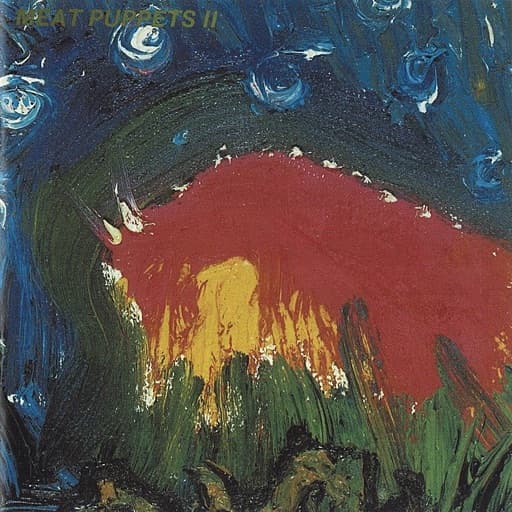
By the early ’80s, the tenets of hardcore had calcified into a strict code of conduct, with pummeling guitars, slam dancing, and shaved heads all de rigueur. On the underground punk circuit, the Meat Puppets’ long hair and psychedelic jamming were widely disdained. It was only a matter of time before the band’s volatile mix of influences would breach containment on Meat Puppets II, a sun-baked, country-fried, acid-addled cowpunk album that could have come from nowhere else but the Arizona desert. With its release in 1984, the Puppets proved that hardcore’s independent network of bands, labels, and venues could be harnessed for much stranger deeds.
Chances are that if you listened to college radio as it transformed into alternative rock in the late ’80s, your favorite band’s favorite record was Meat Puppets II. The album earned the respect of contemporaries like R.E.M., Violent Femmes, and Melvins, but it inspired awe in younger acts. Soundgarden’s Kim Thayil speaks of II in reverent tones; Lou Barlow has called it a “blueprint” for Dinosaur Jr. Of course, the Puppets’ most consequential fan would be Kurt Cobain, who invited the band to play three songs from II on Nirvana’s MTV Unplugged in New York. After that performance, the Meat Puppets would forever be linked to the grunge movement and cited as the primary influence of its tragic figurehead. Yet the Meat Puppets always lagged behind, even on the trail they helped to blaze. It took 10 years for them to catch up to the success of the bands they’d influenced with II; in the meantime, they labored away in the underground as their peers signed to major labels. Finally, caught in the whirlwind of Nirvana’s rise to superstardom, the Puppets experienced their own brief moment in the sun—only to crash down again.
Phoenix in the early ’80s was home to a tumultuous punk scene centered around Madison Square Garden, a dilapidated wrestling ring in the bad part of town. Its denizens made the Meat Puppets look conventional: Frank Discussion, lead singer of the Feederz, was a follower of Situationist philosophy known for killing rats onstage. Killer Pussy’s Lucy LaMode threw dead fish at her audience as she sang songs like “Teenage Enema Nurses in Bondage.” JFA, or Jodie Foster’s Army, was formed just a few weeks after John Hinckley Jr. tried to assassinate Ronald Reagan to impress the actress—the group’s name was a dark bit of satire from a band whose singer was only 14 years old. The Puppets reveled in this chaos even as they sought to branch out from the local scene. “There was people in Phoenix before us that influenced us, that never made it out,” Curt would later say on a New York public access show. “We’re the first band that got outta there.”
They began sending out recordings, making connections in the L.A. punk scene that had inspired them. The song “Meat Puppets” first appeared on a Los Angeles Free Music Society cassette, and then “H-Elenore” became the only track from an Arizona band on the SoCal punk compilation Keats Rides a Harley. The L.A. band Monitor invited the Puppets to record a song for their debut album in exchange for some studio time, which they used to produce the In a Car EP, five tracks of red-hot hardcore that scream by in as many minutes. These early songs outpaced even the fastest bands in Los Angeles. “We were gaining fans out there, because I guess we could play fast and were totally insane,” Curt told journalist Greg Prato. “We had developed this way of playing a lot faster than most of the punk rock.”
The Puppets’ technical precision and lunatic live shows grabbed the attention of Joe Carducci and Greg Ginn at SST Records, home to an increasingly diverse stable of underground DIY bands including Black Flag, Minutemen, Saccharine Trust, and Hüsker Dü. Ginn, SST founder and Black Flag guitarist, asked them to record their debut for the label, leading to a long and contentious relationship. The Puppets recorded the self-titled album over a three-day acid bender on Santa Monica Boulevard. This was a looser and more varied outing, featuring roaming psychedelic detours as well as hyper-focused hardcore. It was also their first recording to hint at their desert origins through covers of Western hits like the Sons of the Pioneers’ “Tumbling Tumbleweeds” and Doc Watson’s “Walking Boss.” The Puppets’ version of the former is a piss-taking parody with bratty, mocking vocals, but “Walking Boss,” an indignant workers-rights song, is played straight, making plain the band’s sincere debt to folk and country.
But between their debut and Meat Puppets II there’s a rift the size of the Grand Canyon. Ask each member to explain the band’s sudden evolution and you’ll get three different answers. Bostrom told Carducci that “from the beginning of the band Curt and Cris could play anything, and now that he also could play anything they were no longer a punk band.” Cris demurred, telling Matthew Smith-Lahrman that “to us there wasn’t that big of a shift between Meat Puppets I and Meat Puppets II.” For Curt, though, it was simple: “Because I wrote it, and Cris and Derrick wrote most of the first one!”
The shift in songwriting duties goes a long way toward explaining the Western-gothic tone that permeates II. Explaining how exactly Curt wrote such compellingly oblique poetry on his first set of songs is more difficult. The drugs certainly helped. Two of the album’s best tracks, “Lake of Fire” and the instrumental “Magic Toy Missing,” were written during an acid trip while Curt’s friends were at a Halloween party. “‘Lake of Fire’ was kind of like, ‘Oh, the bad people! They're out tonight—look, it’s Frankenstein and the Mummy!’” he told Prato. “‘Magic Toy Missing’ was from looking at the moon and it was making a kaleidoscope happen, when you’re tripped out like that. I tried to make a musical version of the Spirograph sort of thing that the moon was doing. I wrote them both in about 20 minutes.”
But any attempt to write off Curt’s songs as the product of an altered state only tells half the story. He drew on a language of religious fervor that was deep-seated and purely American:
Where do bad folks go when they die?They don’t go to heaven where the angels flyThey go to the lake of fire and fry**Won’t see ’em again till the Fourth of July
Now people cry and people moanLook for a dry place to call their homeTry and find someplace to rest their bones**Before the angels and the devils fight to make them their own
The drama of perdition is painted with such simplicity that it seems cribbed from a children’s rhyme, the Book of Revelation compressed into a two-minute sketch.
Curt constructs a new character for II: the slacker-prophet, who, like an omniscient desert flâneur, observes everything that happens from his position of relative idleness. “Plateau” describes striving toward the afterlife as scaling a grand plateau where “holy ghosts and talk show hosts are planted in the sand/To beautify the foothills and shake the many hands.” But our narrator remains unbothered; he knows that “there’s nothing on the top but a bucket and a mop/And an illustrated book about birds,” nothing to meet the newly deceased at their goal other than mundanity. These songs seem like they’ve always existed, like they’ve been channeled from some hymnal lost and forgotten in the sand. But Curt, when pressed, will pause and shrug and say it’s “probably just desert stuff.”
Expressing these strange allegories of doomed America required something new of Curt. Now that he’d written these haunted honky-tonk songs, he dropped his hardcore screaming and adopted a vocal style somewhere between a bored drawl and a strained caterwaul. It also required buy-in from his bandmates, who he recalls as having to be convinced of the Puppets’ country pivot. But Cris and Bostrom didn’t seem to mind. In fact they savored the opportunity to get high—this time the drug of choice was MDMA, scored off an ASU chemistry prof and gulped down in double-locked capsules—and play like their heroes. Bostrom loosened up and played simpler, more expressive drums like his idols Ringo Starr and Keith Moon, while Cris filled up the newly created space with busy, percolating bass lines inspired by Phil Lesh. These were not trendy names in Los Angeles’ punk scene in 1983, but the Puppets embraced their most unfashionable impulses, sticking up for the mainstream yet somehow becoming outsiders even to the outsiders.
The Puppets didn’t immediately reveal their new direction on II. Album opener “Split Myself in Two” could pass as a hardcore song, maybe, with all three Puppets racing each other to the end until they are overtaken by the washes of distortion pouring out of Curt’s guitar. Except that the lyrics give the lie to any punk rock posturing: For those paying attention, the song serves as the introduction to Curt’s mystical main character, who sells his soul for “the card that said I never would fall.” For the rest of the song, and the rest of the album, he’s in a panic about the return of the devil, who “said I’m leaving now but I want what you owe me/I’ll be back in a little while.” Similar paranoid encounters litter the album, as if the singer is on the run across a degraded West that, despite its scope, is still claustrophobic and mean.
“Lost” finds him on the highway in search of a safe haven. It’s a road song worthy of Johnny Cash, but if he’s been everywhere, man, Curt has been nowhere, doing laps around the desert. A shuffling beat and a walking bassline propel him forward, but he’s “lost on the freeway again/Looking for means to an end,” running out of favors and running out of friends. He does his best cowboy impression, complete with unhinged “Yahooo!,” and it’s almost believable; more authentic is his dexterously picked guitar solo, which has a twang more befitting the Grand Ole Opry than the Whisky. The inverse of this suffocating West is Curt’s inner world. “I can’t see the end of me,” he sings on “Oh, Me,” “My whole expanse I cannot see.” It’s a classic stoner conceit of glassy-eyed introspection, finding freedom in his mind as he’s caught wandering the arid plains.
Despite the freewheeling drug use, the Puppets were focused on what they knew would be their statement album. “We recorded it a lot more carefully,” Bostrom told Prato. “We sat down and tried to make the arrangements different, we worked more closely with [SST producer] Spot, chased more people out of the studio—it was just the three of us working intently.” They completed the record in May 1983, but their statement would be delayed. SST did not have the record mixed until November of that year, and it wasn’t released until April 1984, an eternity in the quickly evolving world of punk rock.
Still, II pissed off the punks. Playing these navel-gazing, shit-kicking songs on the hardcore circuit was never going to be easy, especially opening for Black Flag, who were a lightning rod for aggressively macho crowds. But the Puppets didn’t even try to meet them in the middle; if anything, they ran in the opposite direction. They treated their audiences to 15-minute-long Grateful Dead covers. They played selections from Elvis and the Beatles. They practiced their harmonizing with Everly Brothers tunes. In return they were spat at and physically threatened. Not to be intimidated, Curt and company would then scream obscenities and play sloppily on purpose. A portion of the audience would always stick it out anyway, drawn in by their audacity. As with the Replacements, the Puppets put on a good show even when they were bad.