
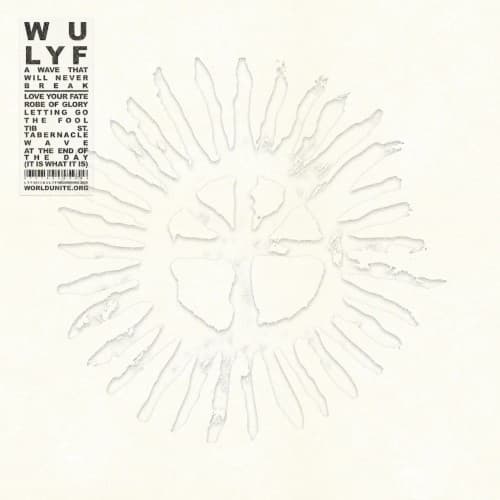
When Ellery Roberts announced, “WU LYF is dead to me,” in late 2012, it wasn’t just the best possible outcome for the Manchester band’s legacy; it was the only one. Released a year and a half prior, Go Tell Fire to the Mountain was a debut of unwieldy philosophical and musical underpinnings—post-Occupy agitprop, Afro-pop guitars, a pipe organ and a guy who sang in Tom Waits Simlish, an antagonism to the UK press that the UK press couldn’t stop writing about—bound together by the urgency and energy of four young men who valued martyrdom as the ultimate form of rock’n’roll mythmaking. And so for the next 14 years, they were beloved like so many doomed revolutionaries who put themselves at the front of the insurgency so they wouldn’t have to deal with the committee meetings and paperwork that comes after. Treasured memories of “We Bros” and “Spitting Blood” and the last gasps of blog-rock hype could remain forever intact, uncomplicated by anything as mundane as a pretty good second album. A decade and a half years later, A Wave That Will Never Break throws a hitch in WU LYF’s pyrrhic reputation: a great second album.
And by great, I mean, “big or immense.” For the second time, the opener (“Love Your Fate”) plays on the band’s acronymic name in pursuit of a theme song that transcends the merely anthemic. After a fake-out fade-in, WU LYF find a new row of cheap seats to aim for every 30 seconds or so—splicing a military drum roll into the chorus before the harmonies kick in; shouting “build it all up” and hammering a kick drum on every accent of “BURN. IT. BACK. DOWN”; and, of course, the call-and-response coda for anyone yet convinced. While all of their Big, Evangelical Rock Music countrymen of the early 2010s pivoted to downsized electro pop, padding out the NME-beloved epics that got them to Glastonbury, WU LYF have barely altered their template; “Love Your Fate” ends up sounding like the past 40 years of arena-ready alt rock and, for that reason, utterly novel in 2026.
The ensuing six songs stretch from five to nearly 11 minutes, and Roberts speaks only in terms of unforgettable fires, hurricanes and tidal waves, sleeping in the gutter and dreaming of the stars; the album ends with a closing-credits piano ballad expressing a unified WU LYF theory of everything. WU LYF’s ambitions have not abated in the slightest since Go Tell Fire to the Mountain, an album that eased its path towards the rafters with cathedral reverb sourced from an actual abandoned church. They’ve just become more clarified, stripping away the booming echo that once obscured that group’s limber musicianship, while Roberts has sheared the most jagged nodes from his trachea and, with them, a language of completely unprecedented vowel sounds. If they’re still self-identifying as “heavy pop,” a convincing grasp of funk, soul, and maximum R&B helps lighten the load (only the thuggish, sluggish throwback “Robe of Glory” slows the momentum).
But if this kind of proselytic rock has moved you at any point in your life, it’s likely that you’ve eventually moved on: to music less inclined to view everything in Manichean terms, to artists who don’t aspire to be saviors and risk making you feel like a sucker. Like its predecessor, nearly every second of A Wave That Will Never Break tempts skepticism, albeit an inversion of that which WU LYF once inspired. Roberts is the guy you remember from long, drunken bull sessions about Situationist politics and Dischord Records, now having a middle-aged Led Zeppelin phase (“Tib St. Tabernacle”) and echoing slogans people learn from 12-step programs, Thich Nhat Hanh books, or some combination thereof.
If the L Y F membership model seems like a remnant of WU LYF’s anti-promotion-as-promotion, it’s a load-bearing part of the experience; at a time where even U2 surprise drops come and go like a Friday news dump, WU LYF are suited for a paradoxical paradigm where “arena rock” appeals to a smaller, self-selecting audience. This time around, the question isn’t how many new recruits will be swept up in A Wave That Will Never Break, but how much it energizes the base. And if there’s any lingering, primal need for rock bands who ask the biggest questions in a way that makes people think they have the answers, it’ll be satisfied by “Letting Go.” By the time Roberts adds a surprisingly tender falsetto howl over the windswept chorus, it’s transformed into a Proustian highlight reel of whatever codified Big, Evangelical Rock Music in your formative years: Bono extending “Bad” to 12 minutes at Live Aid as if lives depended on it, because they literally did; Coldplay recognizing the healing powers of “Fix You” in real time at the quasi-sequel Live 8; Richard Ashcroft introducing “Bitter Sweet Symphony” as a “modern day blues song” and Jason Pierce stowing away on the Atlantis space shuttle with nothing but his Elvis tapes and a couple bags of junk; scouring album credits for information on producers with superheroes’ names—Flood, Youth, Sonic Boom. WU LYF enlisted the latter on A Wave That Will Never Break, if only to shrink the one degree of separation between themselves and their heroes, whose influence is unmistakable in the spiritualized (in all forms) junkyard gospel of “Wave.”
At times, it feels like I’m talking about A Wave that Will Never Break like a chiropractor: I imagine the new-age spirituality could make it seem like complete bullshit, but trust me, you’ll feel like a new person after 45 minutes. So where to draw the line? Because it can’t just be whether or not they mean it. The worst music you’ve ever heard has probably come from a place of pure sincerity. Rather, it’s a question of whether the performance is so convincing that you believe they believe it. Though WU LYF have taken notes from the great rock’n’roll swindles of the past, their faith has never wavered. Roberts is one of the thousands of artists who namedrop Fugazi as an ethical paragon, but he’s done so in conjunction with Spiritualized and Barcelona F.C., two wildly divergent examples of committing to the bit. My most cherished memory of WU LYF came not from their galvanizing Coachella performance, but immediately afterwards, when I spotted Roberts wandering around the Empire Polo Club wearing a denim jacket with a giant WU LYF patch on the back. It was probably 90 degrees out at the time.
Then and now, that image serves as a perfect snapshot of their symbiotic earnestness and absurdity, the interrelation between the stone of shame and the stone of triumph, of Celebration Rock and Embarrassment Rock. But for some people, nothing delivers the same feeling of deliverance—not Terrence Malick movies, not epic novels, not marathon house tracks—as someone emoting themselves raw over guitar harmonics echoing out into the great middle distance. The L Y F membership is for anyone who still hadn’t found what they were looking for after these years, until they realized the only substitute for WU LYF is more WU LYF.