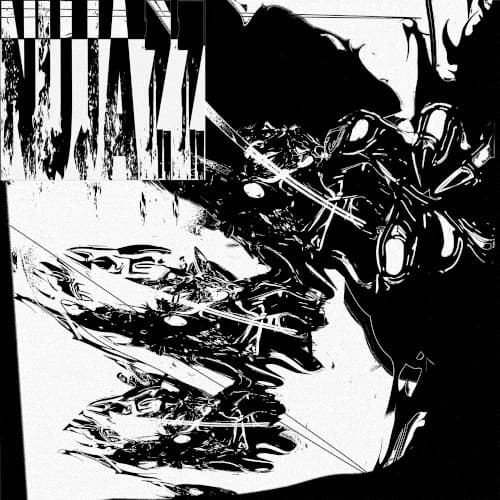


In the beginning was a really obnoxious trumpet, and the trumpet was with M.I.A., and the trumpet sort of was M.I.A., insofar as a split-second sample of the Rocky theme tune could represent a musician’s entire way of being in the world. A loud noise torn from its source, demanding attention. BLAARP. The plasticky fanfare of that ’70s horn (plundered from Bill Conti for the art school rapper’s breakout single “Bucky Done Gun”) makes a prophetic return, seven times over, on M.I.7—an emotional and ecstatic testament to personal salvation, which is, as advertised, M.I.A.’s gospel album.
Fearless, naive, maddening, vindicated, and forever courting controversy, M.I.A. has been working at the intersection of art and the artist for over 20 years. She’s always rapped with the old-time swagger and conviction of Chuck D, mixing playground boasts with the hard facts of an unequal system: guns, borders, refugees, cops. In particular, her music has mirrored our relationship with the internet, from the promise of Web 2.0 to the betrayal of Wikileaks to wherever we find ourselves now, with the dream of the global village foreclosed by state surveillance, corporate greed, and conspiracy grift. M.I.A. was early to sniff those winds of change—often laughed at, sometimes proven right, occasionally covered in tinfoil herself. Her current position, though, is one of retreat: get offline, scramble your data, shield yourself from electromagnetic frequencies with a silver-coated poncho (available from her OHMNI store). She still tweets, of course—M.I.A. will never log off—but her seventh album has unplugged itself from the global-political-media-matrix in the most decisive way imaginable.
Christianity provides the concepts, lyrical imagery, and even musical vocabulary for M.I.7, with choral uplift provided by the Sunday Service choir (founded by the born-again Ye for 2019’s Jesus Is King). Organized around seven trumpet interludes, M.I.7 begins with a horn and a voiceover. “Seven days of creation in the sevenfold spirit of God, seven candlesticks, seven golden balls,” she intones, choosing apocalyptic fragments from the Book of Revelation, “then the seven horns played near the altar.” Cue trumpets, before a Simpsons-esque parting of the clouds reveals “Prayer 777”—a rundown of her new faith over a cumbrous breakbeat and soupy strings. It feels almost impossibly weighed down by allegory—“Love my son like I’m Mary,” she adds in her usual deadpan—but it’s somehow more direct and more emotional than anything she’s released. Then it’s “time for the second trumpet” as we receive “Jesus,” an almighty pummelling of juddering bass, dissonant syndrums, glitching vocals, and fibre-optic deliverance: “My mind body spirit is calm/When God speaks I downloaded the psalm.” It’s like standing under a waterfall.
Words and sounds, symbols and meanings, are the essence of her artistic practice. In the mid-2010s, M.I.A. was rediscovering Hinduism, the religion she knew from her childhood in Sri Lanka, and mostly investigating her namesake, the Hindu deity of speech and creativity. But some time after releasing 2013’s Matangi, M.I.A. “was visited by the Word,” as she recounted to fans on Instagram Live recently. She had a full-on vision of Jesus. “I think the message was just to get to a peaceful place,” she later told Zane Lowe. Far from being restricted by her theme, M.I.A.’s Christian songwriting feels unencumbered, more genuinely experimental. On “Money” she recites an inverted prosperity prayer over the wackiest beat on the album (made with producer Swick, who appears throughout along with Thom Bridges, Kurtis Wells, and Boaz), smashing together waterlogged drums, plastic flutes, and stressy phones ringing off the hook: “When I get it I’ma give some to the poor/Then I’m gonna stay getting even more,” she offers, not entirely charitably: “Everyone is calling me, what they want is my money.”
There’s a thrown-togetherness across the record that chimes with the scruffy, half-baked tendencies of 2020s underground rap, and an off-grid eccentricity that harks back to private press devotional music, like the recently reissued album from Sister Irene O’Connor with her ‘70s organ and drum machine, or the ecstatic music of Alice Coltrane’s ashram choir. It’s sometimes messy: another take might have yielded better results on the cloudy fantasy of “Circle,” which lands with ninja precision before spiraling off-key and out of focus. Some songs feel like the first draft of something bigger and poppier, limited by their rudimentary structure. But such gripes would miss the point of M.I.7, a record that embraces the simplicity of the Way, the Truth, etc. (“I always found the concept of Christianity quite basic,” she admitted to Lowe.) Her impromptu relationship with Jesus is strictly personal, after all, revealed to her through ineffable experience rather than handed down by custom or law; it’s the spirit that breathes through centuries of Christian music, from Hildegard von Bingen through John Coltrane, Bob Dylan, and Robert Hood.
Cynically speaking, it’s obvious that M.I.A.’s embrace of Christianity feeds her personal desire for rebellion. Some people just have to be different, don’t they? And like certain other divisive public figures who’ve recently found God, she seems to enjoy amplifying the negative reactions, if only to confirm her underdog status: “The fact that the biggest backlash in my career and life [came] after saying ‘Jesus is real’ is such a revelation to me,” she tweeted in 2022. Rapping about her love for Jesus, rather than, say, Julian Assange, also keeps her from licking the electric fence of political controversy (at least in song form—separate hearings will be needed for her tweets about vaccines, Alex Jones, and “Jewish blood lines.”)
So what is it that feels so right about M.I.7? M.I.A. has always portrayed herself as a truth-seeker, someone forever skeptical of official wisdom and infuriated by Western hypocrisy. Perhaps a leap of faith was her only route to a satisfying answer. “We can now rest from all the trumpets getting lit and finally have some drumming,” she says over the seventh fanfare, before the album closes with “Everything.” Thick with gospel voices and gathering strings, heavy like church but warm like the sun, it ends on a high note that echoes through the final track—the self-explanatory “30 Minutes of Silence,” a boundaried moment of emptiness, maybe prayer. A reminder to shut up for once. In the self-edited video for “Everything,” M.I.A is dressed in white and dancing in the desert when she’s joined by three boys, possibly by chance. They start dancing together, and she’s got this massive smile on her face. I don’t think I’ve seen her smile like that before.