
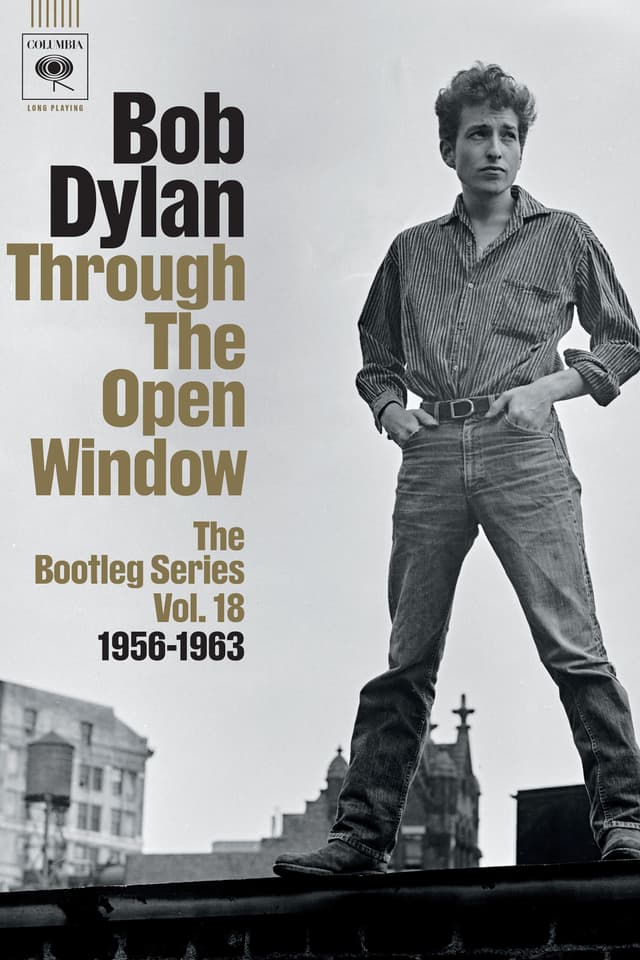
Of all the revelatory sets in the Bootleg Series that have given us insights into Bob Dylan's creative process, decision-making, and strangely high batting average for following the most fruitful songwriting impulses and instincts, nothing could prepare us for how comprehensively complete Through the Open Window is, as an evidence-based origin story.
In a strange coincidence, it was purportedly in production by Legacy Recordings well before A Complete Unknown and Timothée Chalamet's depiction of Dylan intrigued a young generation of Chalamet's fans to ponder exactly where this Bob Dylan guy may have come from. But it does tread much of the same temporality as the film, except it starts and ends earlier, and shows us some things we likely never expected to see.
Co-produced by American historian Sean Wilentz and music producer Steve Berkowitz, Through the Open Window features Dylan's earliest known recordings and his first live performances of culture-altering songs like "Blowin' in the Wind." More than usual for a Bootleg Series edition, the fidelity of each recording can vary greatly, as some songs were captured by Dylan or his colleagues with rudimentary equipment, or surreptitiously by audience members who presciently recorded a young man who seemed to be in a constant state of metamorphosis from one week to the next.
In his extensive liner notes, Wilentz tells us that the first thing we hear — a version of Shirley and Lee's "Let the Good Times Roll" — was a DIY recording made at Terlinde Music Shop in St. Paul, MN, on Christmas Eve, 1956. Bob Zimmerman had taken a Greyhound bus to St. Paul from his family's home in Hibbing to hang out with his friends and make some music in the band they had, the Jokers.
The 78-acetates they cut that day are short (this selection lasts just 37 seconds) but yes, the future Bob Dylan is present, playing piano and singing with the joy of a young Jokerman, and history was made; Zimmerman was 15 years-old and just made his first recording. Four years later, he was documented exploring the acoustic guitar and writing his own material in a doo-wop vein, like the slight "I Got a New Girl," which features him employing what we've come to call his sweeter, high Nashville Skyline voice from the late 1960s. As he made his circuitous route to an ailing Woody Guthrie and New York City's clique-y yet somehow also inclusive folk music community (which, again, was reductively depicted in A Complete Unknown), Dylan absorbed as many aspects of folk culture — and its alignment with enlightened intellectuals, equality-driven moralists and working-class people — as he could. He also often told tall tales about where he came from, almost as if he was attempting to will people into believing he was a character in the kinds of folk standards he sang come to life.
It's a period in the legend of Dylan that has elicited as much scrutiny and scorn as it has awe, because some living through it and others analyzing it from decades of distance, have dismissed him as an opportunistic Guthrie-copycat and folk peer plagiarist, who never heard about a subversive character, story, or song he wouldn't claim as his own counter-cultural invention.
But over the course of 139 multi-sourced recordings of songs he learned and songs he wrote (collected here as an eight-CD box set), Through the Open Window does a kind of forensic tracking of Dylan's earliest discoveries of artists, songs, fashions, jokes, diction, accents and stage personas — some of which he adopted and discarded, others being so foundational that they're present within his expression to this day. What he made of them in short order sounds less like craven pretension, and more like the product of genuine curiosity, respectful study and insatiable knowledge-building.
If Dylan were truly a thief, providing evidence of all of the plotting and scheming that led to his alleged song crimes via the hyper-transparent Bootleg Series would surely be a foolish gambit. Instead, the series is steadfastly in the inspiration business, frequently demonstrating that to become someone is to go through creative processes in life and, in a public one, you might evolve quickly and paradoxically."
But to live outside the law, you must be honest," Dylan would later sing on 1966's "Absolutely Sweet Marie," having seemed to have foreseen this credo as soon as he received (and ostensibly ignored) the first suspicious looks cast his way in Greenwich Village. That this fact-finding case folder of curios and Dylan's earliest appearances on record — including pre-fame sessions where he was asked to play harmonica by the likes of Victoria Spivey and Harry Belafonte — concludes with his triumphant headlining set at Carnegie Hall on October 26, 1963, is no accident.
In Wilentz's extraordinary, 125-page liner notes (it's a book!), he makes the case that Dylan's artistry ascended so quickly in the two and a half years since he landed in New York, we might still be taking it for granted. When he took the stage that night, his second album, The Freewheelin' Bob Dylan had been released and acclaimed, and its follow-up, The Times They Are A-Changin', was recorded and waiting in the wings. However, many of the faithful in attendance who'd already seen him play these unreleased songs live greeted them like the future classics they were, with proto-Beatles screaming and fervour. It's as though they recognized the great leaps and mastery of his craft that Dylan had rapidly achieved.
Indeed, Wilentz suggests that for all the attention and historical import that now canonized songs like "A Hard Rain's A-Gonna Fall" from Freewheelin' and even "The Times They Are A-Changin'" have earned, they might not match the intricate literary and songwriting achievements of the more subtle, lesser known "Only a Pawn in Their Game" and "The Ballad of Hollis Brown," which reveal the beyond-his-years, socially conscious lyrical force that Dylan really was. By the fall of 1963, he had so conquered and reinvented the sincere folk realm, he was already moving beyond it, to innovate again as the surreal, subterranean stoner rock poet he'd soon become.
From the inception of its towering, inaugural career overview, the Bootleg Series has been a gift for Bob Dylan fans. For younger followers, few sets could match Vol. 8, Tell Tale Signs, which covered his work between 1989 and 2006, because its treasures were truly a shock — and they remain deeply mysterious. But an argument can now be made for the significance of Through the Open Window, because it's ground zero. Although large chunks of the material have circulated previously (as, well, bootlegs), the restorative sonic care and Wilentz's chronological contextualization is invaluable.
Through The Open Window features a young, impassioned Bob Dylan (who, in every performance here, attacks the material like he really, really means it), squarely situated between Harry Smith's Anthology of American Folk Music and The Basement Tapes, with the spirit of discovery, joy, ambition, reverence and American exceptionalism propelling him into the greatest songwriter and musical force of our time, right out of the starting blocks.